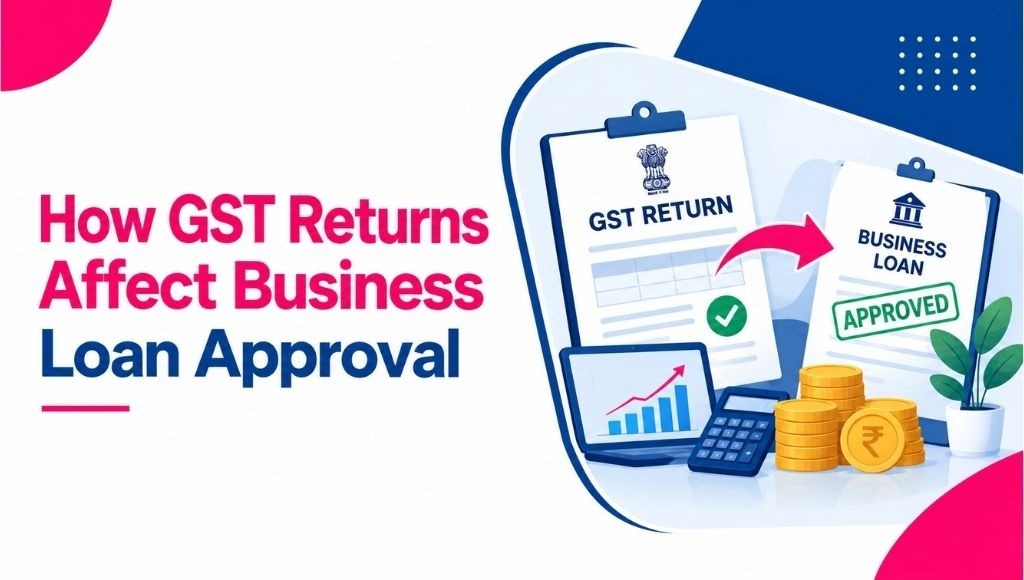
GST returns can affect business loan approval because they give lenders verifiable information about a business’s sales, tax liabilities, filing behaviour and overall financial activity. For GST-registered businesses, this data may help lenders assess revenue consistency and repayment capacity alongside bank statements, income tax returns and financial statements.
However, GST compliance alone does not guarantee loan approval. Eligibility also depends on factors such as credit history, existing debt, cash flow, business vintage and the lender’s internal underwriting criteria.
What Are GST Returns and Why Do They Matter for Business Loans?
GST returns are periodic filings submitted by registered taxpayers to report transactions and tax-related information. They can provide lenders with an additional source of financial data when evaluating a business loan application.
According to the GST Portal, Form GSTR-1 contains details of outward supplies of goods and services, while GSTR-3B reports summarized tax liabilities and relevant tax information.
What Information Do GST Returns Show Lenders?
GST records can help establish information such as:
- Reported sales and outward supplies
- Monthly or quarterly business activity
- GST liabilities
- Return filing history
- Changes in reported turnover over time
This information can be compared with other financial records to build a broader view of business performance.
How GST Compliance Reflects Business Financial Activity
Consistent GST filings can indicate that a registered business is maintaining regular tax records. They also create a documented transaction trail that may support cash-flow-based credit assessment.
SIDBI notes that GST information, bank statements and income tax return data are already being combined in digital MSME credit assessment models such as FIT Rank.
How Do GST Returns Affect Business Loan Approval?
GST returns may influence approval by helping a lender verify revenue, analyse business activity and identify inconsistencies between different financial documents. They are usually one part of the overall credit assessment rather than the sole approval criterion.
GST Turnover and Business Revenue Assessment
Reported turnover gives lenders an indication of the scale and consistency of business activity.
For example, a business reporting relatively stable outward supplies over several filing periods may present a different financial profile from a business whose reported sales fluctuate significantly. Lenders may use this information alongside bank credits and financial statements instead of relying on turnover alone.
GST Filing Regularity and Compliance History
Regular filing can make financial verification easier because recent records are available for assessment. Repeated delays or missing returns may require additional clarification or documentation. However, delayed filing does not automatically mean that a loan will be rejected.
GST Returns and Business Cash Flow Assessment
GST data can help lenders understand sales trends, but it should not be treated as the same thing as cash flow.
A business may report strong sales while experiencing delayed customer payments. Therefore, bank statements, receivables and existing obligations are also important when determining whether the business can comfortably repay a loan.
GST Data Verification During Loan Processing
Digital lending systems increasingly use multiple data sources for verification. SIDBI has highlighted straight-through MSME loan processing based on a combination of GST information, income tax returns and bank statements. This reduces reliance on a single financial document and helps create a more complete picture of the borrower.
Why Do Lenders Check GST Returns Before Approving a Business Loan?
Lenders may review GST returns because the records can provide independently filed transaction information that helps validate details supplied in a loan application.
To Verify Reported Business Turnover
If a borrower declares a particular level of annual sales, GST filings can help verify whether reported outward supplies broadly support that figure.
To Assess Business Stability
Several months or years of returns can reveal patterns in business activity. Stable or growing sales may support the assessment, while sharp changes may require further explanation.
To Identify Filing Irregularities or Compliance Issues
Missing or delayed returns can signal that additional verification may be necessary. The impact depends on the lender, the reason for the irregularity and the applicant’s overall financial profile.
To Compare GST Data With Other Financial Documents
A lender may compare GST figures with:
- Bank statements
- Income tax returns
- Profit and loss statements
- Balance sheets
- Sales records
Large unexplained differences can result in requests for supporting documents.
What GST Return Details Can Influence Business Loan Eligibility?
The most relevant details generally relate to turnover, filing behaviour, liabilities and consistency across financial records.
Annual and Monthly Turnover
Turnover trends can help lenders assess the size of operations and whether revenue appears stable enough to support the requested loan amount.
Filing History and Timeliness
A complete filing history makes it easier to review recent business activity. Businesses should therefore ensure applicable returns have been filed and records are up to date before applying.
Tax Payment and Outstanding Liabilities
Existing tax liabilities may affect cash available for other business obligations. Applicants should accurately disclose significant outstanding statutory liabilities when required by the lender.
Consistency Between GST Returns and Financial Statements
Turnover and transaction data across GST records, books of accounts, bank statements and income tax records should be reasonably reconcilable.
Differences may occur for legitimate accounting or tax reasons, but businesses should be prepared to explain them.
How Can Businesses Improve Loan Eligibility Through Better GST Compliance?
Businesses can improve the quality of their loan documentation by keeping GST and financial records timely, accurate and consistent.
File GST Returns on Time
Submit all applicable returns within the prescribed timelines and review filed information for accuracy.
Maintain Accurate Business Records
Invoices, purchase records, bank transactions and accounting records should be properly maintained so that figures can be reconciled when required.
Resolve Outstanding GST Liabilities
Where possible, businesses should address unpaid liabilities or maintain clear records explaining any disputed or outstanding amounts.
Keep GST and Financial Records Consistent
Regularly reconcile GST filings with accounting software, bank statements and financial statements. Correct records reduce avoidable questions during underwriting.
Is GST Applicable to Business Loans?
GST is generally not charged on the interest component of a normal loan because services involving loans or advances are exempt to the extent that consideration is represented by interest or discount. Other loan-related service fees can be taxable.
Understanding the GST Treatment of a Loan
When discussing GST on business loans, it is important to separate interest from additional services and fees. The tax treatment is not necessarily the same for every component of the borrowing cost.
GST on Loan Interest and Related Charges
CBIC states that interest on loans and advances is generally exempt from GST. This means GST is ordinarily not added to the normal interest charged for lending money.
GST Treatment of Loan Processing Fees and Services
Processing fees, documentation fees and similar service charges can attract GST because they represent consideration for financial services rather than interest.
Financial and related services that do not fall under a specific exemption are generally subject to 18% GST under the applicable service-rate schedule.
What Documents Are Usually Required for a Business Loan?
Requirements vary by lender, loan type and business profile, but applicants are commonly asked to provide documents that establish identity, business activity, income and repayment capacity.
GST Returns and Registration Details
GST-registered applicants may be asked for their GSTIN and recent return information.
Income Tax Returns
ITRs can help lenders review declared income and financial performance over previous assessment years.
Bank Statements
Business bank statements help establish cash inflows, expenses, existing repayments and account conduct.
Financial Statements and Business Proof
Depending on the lender, documents may include balance sheets, profit and loss statements, Udyam registration, business registration records and proof of business operations.
Conclusion: Keep GST Records Accurate to Support Business Loan Applications
Accurate GST returns can make it easier for lenders to verify business activity, turnover and financial consistency, but they are only one part of loan assessment. Businesses should maintain accurate tax records, bank statements and financial statements before applying for credit. If you are comparing options for a Business Loan in Ahmedabad, you can visit BrowseLoan at browseloan.in to review available lending information and understand the application process. Compare interest rates, fees, eligibility conditions and repayment terms carefully before choosing any loan.
Frequently Asked Questions
1. Do GST returns affect business loan approval?
Yes, they can affect the assessment because lenders may use GST data to verify turnover, transaction patterns and filing history. Final approval still depends on the lender’s complete credit evaluation.
2. Can I get a business loan with delayed GST returns?
Possibly. Delayed returns do not automatically prevent approval, but lenders may request updated filings or explanations before making a decision.
3. Do lenders verify GST turnover for business loans?
Many lenders may use GST turnover as one source for verifying reported revenue, particularly for GST-registered businesses. It can be compared with bank statements, ITRs and financial statements.
4. Is GST charged on business loans?
GST is generally not charged on the interest component of loans. However, processing, documentation and certain other service fees may be taxable.
5. Does GST compliance affect business loan eligibility?
It can. Timely and accurate GST records may support financial verification, but lenders also consider credit history, cash flow, repayment capacity, existing liabilities and their own eligibility policies.
References and Sources
- GST Portal — Form GSTR-1 FAQs and guidance on reporting outward supplies.
- Central Board of Indirect Taxes and Customs (CBIC) — GST Sectoral FAQs for banking and financial services..