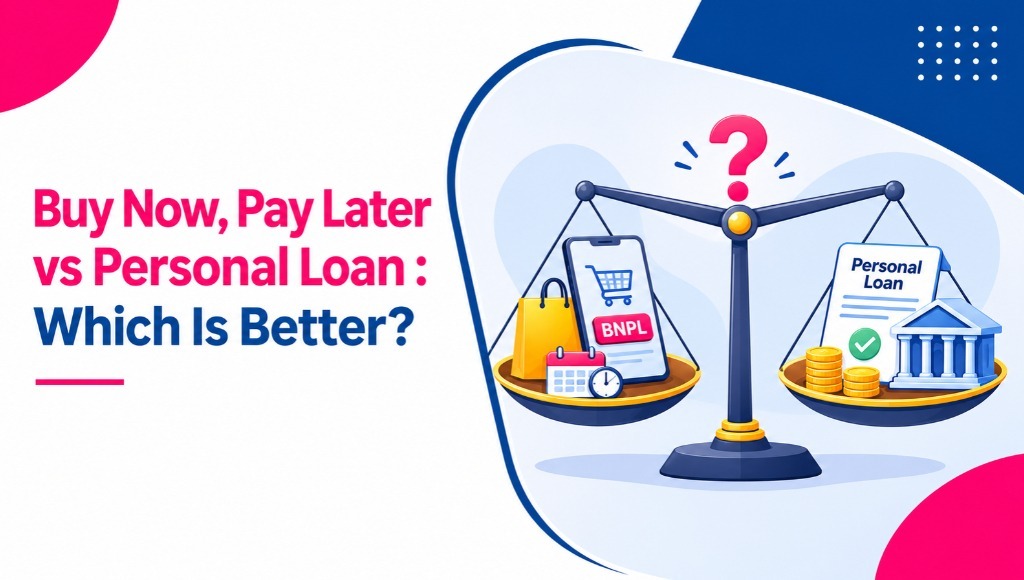
Don’t have enough money in your savings to make a big purchase? There are two commonly used types of credit in India – BNPL and personal loans. You will be able to break the expense into smaller parts, however, the duration, amount, interest rates, and eligibility vary from one another. Check out this article about buy now pay later vs personal loan that helps to compare both options and decide which one is better for you.
What Is Buy Now, Pay Later (BNPL)?
BNPL is a form of credit that enables you to purchase a product and pay for it later in one lump sum or instalments. This form of credit is commonly available during checkout on various ecommerce applications and websites.
A majority of BNPL offers come without any interest when the repayment period is kept under a certain period, which can be between 15 days and 45 days or even split in 3 to 6 instalments. Terms and conditions may vary. Some BNPL offers may come with a convenience fee or interest after a certain tenure. The maximum spending limit is usually low and ranges from a few thousand rupees to about ₹1 lakh based on your eligibility.
How Does Buy Now, Pay Later Work?
- Select BNPL at checkout: Choose the BNPL provider as your payment method.
- Complete verification: Share basic KYC details such as your PAN and mobile number. Approval often takes minutes.
- Make the purchase: The provider pays the merchant on your behalf.
- Repay in instalments: Pay on the scheduled dates through UPI, auto debit or the provider’s app.
What Is a Personal Loan?
Personal loans are unsecured loans from banks or NBFCs, so no collateral is required in order to take out this kind of loan. The lender will transfer the amount directly into your bank account, which you will repay using EMIs on a monthly basis over a period of 12 to 60 months. As the amount will be transferred to you directly, you can use it for almost any purpose you may have in mind.
How Does a Personal Loan Work?
- Application process: Apply for it either online or offline at the branch with your particulars and loan amount.
- Loan eligibility criteria: The lender will look into your income, employment and credit rating.
- Disbursal: If approved, your loan amount will be disbursed to you; it may happen even on the same day.
- EMI payment: You will repay your loan with fixed monthly EMI payments.
BNPL vs Personal Loan: Which Is More Affordable?
In analyzing the cost of BNPL versus that of personal loans, it all depends on the amount borrowed and the speed of repayment. If you borrow a small amount and repay it on time, then BNPL will be less costly since most BNPLs are interest free. However, for large amounts or longer tenures, a personal loan will be less costly.
- Interest: Interest free BNPL only works during the promotion period. Personal loans come with an interest rate of between 10% to 24% annually.
- Fees: BNPL comes with convenience fees. Personal loans have a processing fee of up to 2% to 3% of the loan amount.
- Penalties for late payment: Both have late payment penalties, but the penalty for BNPL is quite high compared to the bill amount.
The best way to compare is through the Annual Percentage Rate (APR) that includes both interest and fees. According to the RBI guidelines, it is mandatory for regulated financial institutions to provide a Key Fact Statement (KFS) that includes the APR prior to signing. One must always look at the total payback amount, not the installment, since there could be hidden fees in the “no cost” scheme.
How Do BNPL and Personal Loans Affect Your Credit Score?
Both can impact your credit score since both are credit products, and the repayment history is an important criterion for your CIBIL score.
Most BNPL products in India come from RBI regulated banks or NBFCs which report account information to credit bureaus. Hence, missing a payment on your BNPL product will negatively impact your credit score as much as missing EMI payments. Defaults can even make taking future loans more difficult. In contrast, making payments on your personal loan EMIs on time improves your repayment history.
BNPL vs Personal Loan: Eligibility and Documentation
BNPL Eligibility Requirements
- Age of 18 or above, with identity verification through PAN or Aadhaar based KYC
- Provider specific approval criteria, often based on spending and repayment behaviour
- A credit check, where the provider requires one
Personal Loan Eligibility Requirements
- Minimum monthly income, which varies by lender and city
- Stable employment or business continuity
- A good credit score, generally 700 or above for better rates
- Manageable existing EMIs and debts
Documents Required for a Personal Loan
- PAN card
- Identity and address proof, such as Aadhaar, passport or voter ID
- Income proof, such as salary slips or ITR
- Bank statements for the last 3 to 6 months, where required
When Should You Choose BNPL or a Personal Loan?
The difference between BNPL and personal loan options mainly comes down to how much you need and how quickly you can repay it.
When Is BNPL a Suitable Option?
- Small purchases like gadgets or clothing
- Short term expenses you can clear within weeks
- Planned purchases with a clear repayment schedule
- Purchases you can repay within the interest free period
When Is a Personal Loan a Better Option?
- Medical emergencies
- Wedding and travel expenses
- Home renovation
- Higher value purchases beyond BNPL limits
- Multiple expenses that need one lump sum
Conclusion
The BNPL option is suitable when making a small purchase where quick payment is required and no interest charges apply. The personal loan, however, is ideal in cases where larger sums of money are required for a relatively long period of time. Therefore, it is important that the borrower should analyze repayment options when comparing personal loans vs BNPL.
Need a personal loan that fits within your means? Contact personal loan offers from BrowseLoan.
FAQs
- Is BNPL better than a personal loan?
BNPL is better for small purchases you can repay within the interest free period. A personal loan is better for larger amounts and longer repayment needs. - Is Buy Now, Pay Later considered a loan in India?
Yes. BNPL is a form of credit, and when offered through RBI regulated banks or NBFCs, it is covered by RBI’s digital lending rules. - Does BNPL affect your CIBIL score?
Yes. BNPL accounts are usually reported to credit bureaus, so timely payments help your score and missed payments can lower it. - Which is cheaper: BNPL or a personal loan?
BNPL is cheaper if repaid within the interest free window. For larger sums or longer periods, a personal loan is often cheaper. Compare the APR to be sure. - Can I use a personal loan for shopping?
Yes. Most lenders allow personal loans for any legitimate personal purpose, including big ticket shopping. - What happens if I miss a BNPL payment?
You may be charged late fees and interest, your limit may be suspended and the missed payment can be reported to credit bureaus. - Is a personal loan suitable for emergency expenses?
Yes. Quick approval, higher loan amounts and fixed EMIs make personal loans a practical choice for medical and other urgent expenses.