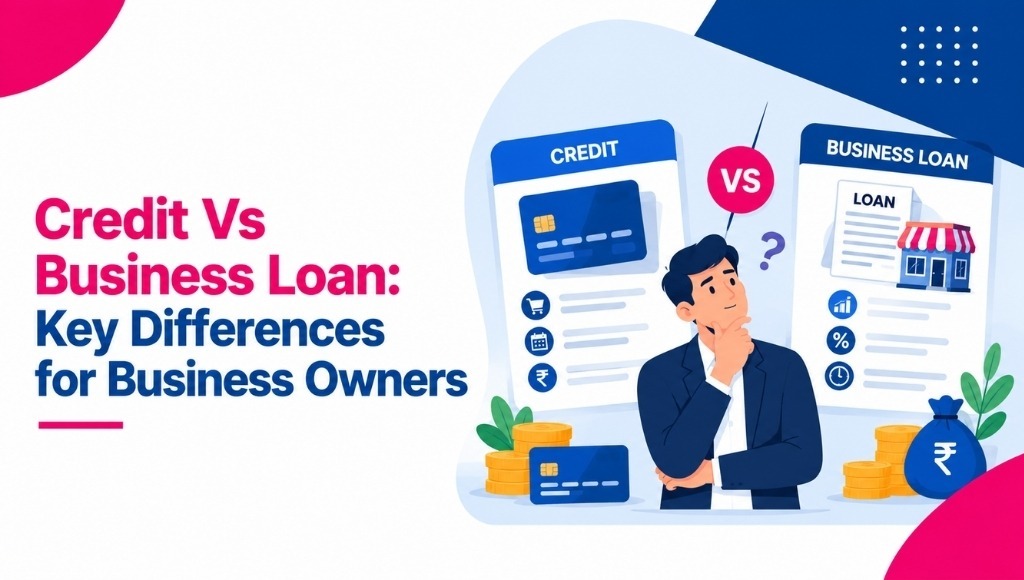
In a business loan, you will get a fixed amount of money at the outset and have to make payments over a mutually agreed term period. On the other hand, there is a line of credit where you are allotted an amount of money that you can draw when required and interest is applicable only on the drawn amount.
It is not possible to determine a better source of financing for all businesses as it totally depends on your requirements for borrowing, the flow of funds, your ability to pay back and whether your requirement for funds is permanent or temporary. If you are looking for a Business Loan in Ahmedabad and are involved in trading, manufacturing, start-ups or services, then it would be beneficial for you to understand the difference between a business loan and a line of credit..
What Is the Difference Between a Business Loan and a Line of Credit?
It can be put in the simplest terms that loans involve lump sum financing while lines of credits involve flexible financing. In case of loans, you get the entire amount at once, and then repay immediately. In case of lines of credits, you do not touch the money until and unless you require them.
What Is a Business Loan?
A business loan is a fixed sum borrowed from a bank or NBFC and repaid through EMIs over a set tenure, often one to five years or more. The interest rate and repayment schedule are agreed at the start, which makes planning easier.
Uses of loan by business owners include:
- Establishment of a new branch/branch expansion
- Purchasing machinery/equipment
- Improvement of infrastructure, like factory or warehouse
What Is a Business Line of Credit?
Business credit facility is a pre-approval of a limit, say ₹10 lakh, from which you can draw as you need. You need to pay interest on ₹3 lakh, if you draw ₹3 lakhs, and so on. When you clear the amount, then you can reuse the same amount.
It is useful for:
- Purchasing stock before the peak season
- Filling up shortfalls due to delayed payments from customers
- Sudden operating expenses
Business Loan vs Line of Credit: Key Differences
| Feature | Business Loan | Line of Credit |
| Funding Method | Full amount paid upfront | Withdraw as needed, up to a limit |
| Interest | Charged on the full loan amount | Usually charged only on the amount used |
| Repayment | Fixed EMIs over a set tenure | Flexible; repaid amounts can be reused |
| Flexibility | Low, as the amount is fixed | High, as you borrow only what you need |
| Best for | Large, Planned, one-time expenses | Recurring or short-term cash needs |
When Should You Choose a Business Loan?
A business loan should be considered if there is clarity on the amount required and its purpose.
- Business growth and new branch establishment: Setting up a new branch in an entirely different location requires a definite amount of money.
- Purchase of equipment/machinery: Purchase of machines by a textile unit can be matched with the loan repayment period.
- Future expenses: Major expenditure in terms of renovations and technological improvements can be easily met through a business loan.
When Is a Business Line of Credit Better?
A line of credit is ideal for companies where the demand for cash fluctuates.
- Managing seasonal cash flows: For example, you might require additional inventory and labor for the Navratri or Diwali period only.
- For purchasing inventory and raw materials: You have the flexibility to purchase material at favorable rates and pay back after selling the product.
- For covering operating expenses temporarily: Payments towards salaries, rent or utilities can be made on time even if payments from a client are delayed.
Business Loan vs Credit Line: Which Costs Less?
Neither alternative is inherently more inexpensive. The cost depends on who the lender is, the interest rate, the fees, the repayment period, and how frequently one uses the facility. In making this decision, look out for the following considerations:
- The annual interest rate and total amount payable: Go beyond the advertised interest rate to the total repayment amount.
- Processing fees, renewal fees, and other costs: There are typically annual renewal fees on credit facilities.
- The method of calculation of interest: See if the interest rate is charged against the whole amount or against the utilized portion.
- Any prepayment penalties, withdrawal conditions, and minimum repayments: These factors may subtly increase the cost.
- Identical requirement within an identical period: Evaluate both alternatives on the same requirement within the same period.
What Should Business Owners in Ahmedabad Consider Before Applying?
- Eligibility and Credit History: Good credit score helps in increasing the chances of approval and getting a low interest rate.
- Turnover and ability to repay: The financial institution evaluates the income statements to check whether you can make the repayments.
- Documents required and total cost of borrowing: Have KYC documentation, bank statements, income tax return and GST returns ready and calculate the total cost of borrowing.
- Comparison among different financial institutions: Banks, NBFCs, and fintech lenders vary greatly in many aspects.
Latest Business Financing Schemes and Updates in India
Pradhan Mantri MUDRA Yojana (PMMY): An announcement about an increased loan limit from ₹20 lakh was made by the Finance Minister in the Union Budget 2024-25 and this increased loan limit came into effect from October 24, 2024. The current loan limits fall into the following categories: upto ₹50,000 (Shishu), ₹50,001 to ₹5 lakhs (Kishor), ₹5 to 10 lakhs (Tarun) and ₹10 to 20 lakhs (Tarun Plus). Tarun Plus is applicable to those people who have already obtained and repaid the loans falling in the category of Tarun.
Credit Guarantee Scheme (CGTMSE): As per the Ministry of MSME, the guarantee limit in respect of this scheme has been increased from Rs. 5 crores to Rs. 10 crores w.e.f. 1 April 2025. The scheme encourages lending to the micro and small enterprises without any collateral or guarantors.
Collateral rules: Another point made by the ministry is that according to the new guidelines issued by RBI on MSME lending, all Scheduled Commercial Banks must not take any collateral security against loans up to Rs. 20 lakh to the units in MSE segment.
Conclusions
A business loan will provide you with a fixed amount that you can use for planned and major investment, whereas a line of credit will provide you with flexible access to money for regular purposes. The best choice will be determined by the purpose for which you want funding and the flow of cash.
Are you considering a Business Loan in Ahmedabad? Find the best one for your business on BrowseLoan.
FAQS
- Is a business loan better than a line of credit?
Not always. A loan is better for large, planned expenses, while a line of credit is better for recurring or unpredictable cash needs. - Do you pay interest on the full credit limit?
Usually not. Most lenders charge interest only on the amount withdrawn, though some may charge a renewal or commitment fee on the limit. - Can small businesses in Ahmedabad apply for a business loan?
Yes. Small businesses, traders and self-employed professionals can apply with banks, NBFCs or under government schemes like MUDRA, subject to eligibility. - What documents are required for a business loan?
Commonly required documents include PAN, Aadhaar, business registration or Udyam certificate, bank statements for 6 to 12 months, ITRs and GST returns. Exact requirements vary by lender.