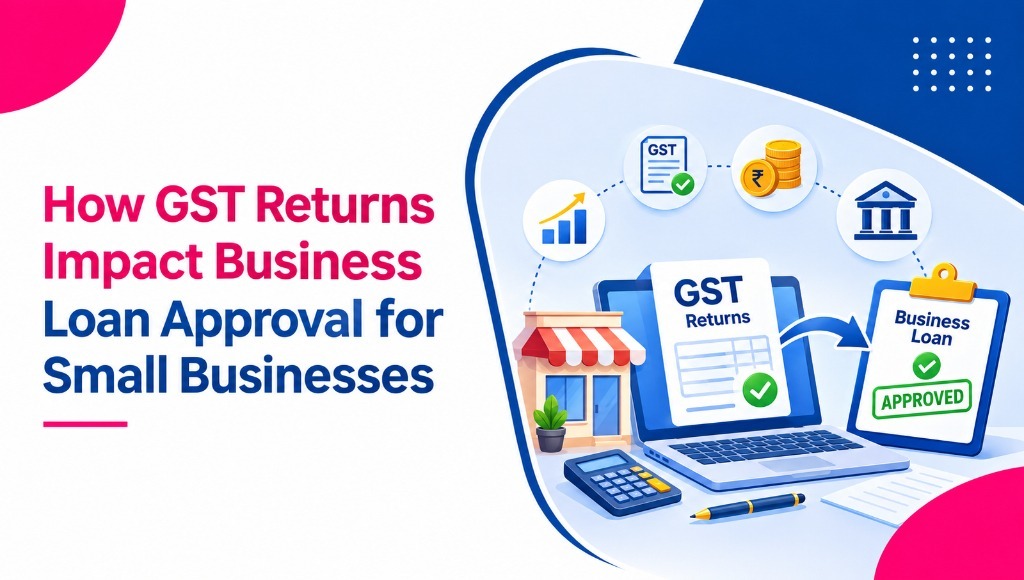
GST returns are not simply a monthly formality that any small business in India has to complete. In fact, it is one of the most trusted sources of information on what the business is buying and selling and how much it is paying in taxes, which is the reason why banks analyze them carefully before approving a business loan.
A bank will need to know three things about your business: is the business active, how much money it is making, and if it can repay the loan comfortably. GST returns are useful because they link all the necessary pieces of information.
What Are GST Returns and Why Do Small Businesses Need Them?
GST is the indirect tax system in India for supplies of goods and services, operative from July 2017. A GST return is a periodic form filled in by the registered taxpayer for reporting details of sales, purchases, tax collection, and credit of input tax.
Filing your returns at the right time will keep you compliant and save you from paying interest and penalties. Filing returns will also create a record of your business activities with a date stamp provided by the government. This is the reason GST returns for loans from banks hold importance.
How GST Returns Influence Business Loan Approval
Help Lenders Verify Business Turnover
Analysis of monthly sales is done to determine if revenue is increasing, stable or decreasing. Also, comparison between the reported revenue and credits in your bank statements is made. Where they correspond almost similarly, the numbers seem to be authentic.
Demonstrate Financial and Tax Compliance
Filing regularly and paying taxes on time show that you are financially responsible. Not filing on time or late filing does not mean rejection; however, it is sure to invite a lot of scrutiny.
Help Assess Repayment Capacity
The trend in revenue helps assess if you earn sufficiently to service an EMI. The lenders analyze the GST figures together with cash flows and profitability since revenue alone cannot tell you the profits.
Support Loan Amount Assessment
Turnovers both annual and monthly help lenders to find out how much credit limit should be provided, whereas the GST turnover history helps in knowing the seasonal variations such as a rise in turnover in the festive season. The credit limit for GST enabled business loan is based on turnover and not on estimations.
Improve Financial Transparency
The GST data is available on the official government portal and hence verifiable. It decreases dependency on self-reported figures and enables the verification of your ITR and financials.
Which GST Returns Do Lenders Check During Loan Evaluation?
GSTR-1
GSTR-1 is related to outward supplies which contain information at the invoice level regarding your sales. This gives information to lenders regarding the volume of sales that you make and who you sell to.
GSTR-3B
The GSTR-3B is a summary of your sales, input tax credit, and taxes paid by you. The lender needs this report to know your turnover and the regularity of your filing. Large variations between GSTR-1 and GSTR-3B raise questions.
Annual GST Returns (GSTR-9)
GSTR-9 is the annual summary statement related to GST transactions for companies that have exceeded the prescribed threshold of turnover.
Documents Required for a Business Loan Along with GST Returns
Exact requirements vary by lender, but most ask for:
- GST registration certificate
- Recent GSTR-1 and GSTR-3B returns, as applicable
- Business bank statements, usually for 6 to 12 months
- Income Tax Returns (ITR)
- Profit and loss statement
- Balance sheet, where required
- PAN, Aadhaar or other applicable KYC documents
- Business registration documents, such as Udyam registration or a partnership deed
How Small Businesses Can Improve Loan Approval Chances Through GST Compliance
Strong GST compliance is one of the simplest ways to improve small business loan eligibility.
File GST Returns Before Their Due Dates
Make reminders for your monthly or quarterly due dates. It is easy to confirm whether your records are well-kept.
Maintain Accurate Sales and Purchase Records
Ensure that you record your invoices accurately for accurate returns and legitimate input tax claims.
Avoid Mismatches Between GST Returns and Bank Statements
Channelize all receipts through your business bank account. Unexpected discrepancies between your turnover and payments is a major sign of an issue.
Maintain Consistent Business Turnover
Stable or increasing income signifies stability. In case your income falls, make sure you give reasons.
Clear Outstanding Tax Liabilities
Outstanding GST payable amount, interest or notice could mean poor cash flow management. Pay them before submitting.
Keep Financial Documents Updated
Update your ITR, P&L and Balance Sheet regularly with respect to your GST record.
Common GST-Related Mistakes That Can Affect Business Loan Approval
- Missing filing deadlines and leaving gaps in your history
- Reporting incorrect sales figures, whether inflated or understated
- Differences between GST records and financial statements or ITR
- Ignoring outstanding tax liabilities or unanswered notices
- Keeping incomplete transaction records that can’t back up your returns
Each of these makes verification harder. In the end, the link between GST filing and loan approval comes down to whether a lender can trust your numbers.
Conclusion
GST returns provide a validated view of your turnover and business activity and help the lender determine repayment ability and an appropriate loan amount. Proper filing and regular turnover will increase your chances of securing a loan quickly.
This notwithstanding, GST returns alone do not guarantee that you get approved. The lender will also consider other factors such as your credit score, outstanding loans, profitability, and age of your business.
For business loans for small businesses, check out the various options available at BrowseLoan.
FAQs
- Do GST returns affect loan approval?
Yes. Lenders use them to verify turnover, check compliance and assess repayment capacity. - How many months of GST returns are required for a business loan?
Most lenders ask for the last 6 to 12 months, though this varies by lender and loan type. - Can a small business get a loan with delayed GST returns?
Possibly, but expect extra scrutiny. Filing pending returns and clearing dues before applying helps. - Does higher GST turnover increase business loan eligibility?
It can support a larger loan amount, but lenders also weigh profitability, existing debt, credit score and cash flow. - Can I get a business loan without GST registration?
Some lenders assess businesses not required to register using bank statements and ITR, though options may be more limited. - Do lenders check GSTR-1 and GSTR-3B before approving a loan?
Many do. GSTR-1 shows sales details and GSTR-3B shows summary turnover and tax paid, so lenders often review both for consistency.