A business requires constant investments either for buying equipment, managing operating costs, growing or keeping the cash flow running. The choice of a funding source for small business owners and entrepreneurs can play a big role in further development.
But often there arises a question – whether it is better to take a loan with an asset or a loan without collateral. Both types of loans have certain advantages, disadvantages, costs and terms of repayment. Knowledge about these nuances will help business owners make the right decisions financially.
In case you are looking for a Business Loan in Ahmedabad, this article will provide information about these two types of loans, their eligibility criteria, documentation and choosing the right funding source.
What Is a Secured Business Loan?
Business loans that are backed by security refer to a form of financing where the borrower backs the loan with an asset. This helps the lender lower his risks and may be able to secure a higher amount of money.
How Does a Secured Business Loan Work?
The borrower secures the loan using an acceptable asset when applying for financing. The lender analyses the asset’s market value, ability to repay, and credit history before accepting the application. In case the borrower does not repay, the lender will use the asset to recover the outstanding amount.
Common Types of Collateral Accepted by Lenders
Collateral, depending upon the policy of the financier, could consist of any of the following:
- Real estate – either residential or commercial
- Industrial land/building
- Fixed deposits
- Machinery/equipment
- Financial instruments
Benefits of Secured Business Loans
Such loans may feature high borrowing capacity, extended loan tenure, and relatively low interest rates. They may be ideal for existing companies that wish to expand or buy expensive machinery.
What Is an Unsecured Business Loan?
In an unsecured business loan, the borrower can acquire finances without having to offer any property or asset as a collateral against the business loan. Instead, the lender will base his decision on the business credit worthiness of the borrower.
How Does an Unsecured Business Loan Work?
The business owner offers all the necessary financial and business documents. These include the income, turnovers, liability levels, and credit status. Based on these, the lender decides the loan limit and conditions.
Key Features of Business Loans Without Collateral
Such finance options do not entail any property valuation and collateral documents. However, a lender can still require the borrower to offer his personal guaranty based on the policies of the lender. Approval and the loan limits will also be determined by the financial standing of the applicant.
Benefits of Unsecured Business Loans
The main benefit of such an unsecured business loan is that the borrowers will acquire loans without placing their properties at risk. It can also be easy since there will be no need to consider the collateral.
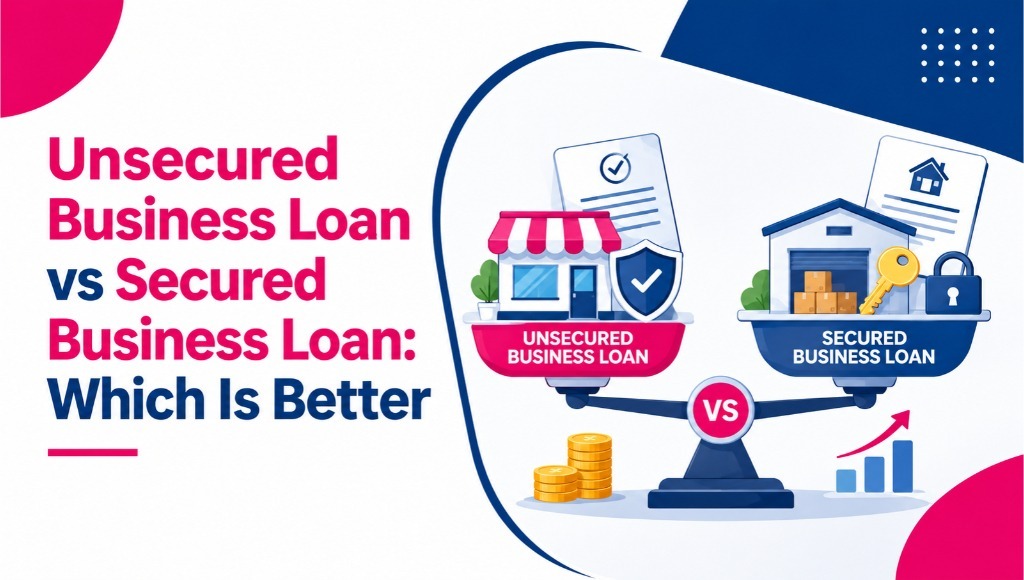
Secured vs Unsecured Business Loan: Key Differences
This awareness will help one choose the appropriate option.
Collateral Requirements
Secure finance entails the requirement of the qualified asset as the means of securing the deal while unsecure finance does not require any collateral from the borrower.
Interest Rates and Loan Costs
Business Loan Interest Rates are contingent on the lender, credit rating, the amount borrowed, loan repayment period and inherent risks involved in the deal. Secure financing will attract low interest due to the involvement of a guarantee in the form of collateral. Unsecured financing will attract high interest rates because the inherent risk will be high for the lender.
Loan Amount and Repayment Tenure
Secure financing will be likely to offer higher borrowing limits and longer repayment terms. Unsecured financing offers borrowing limits that are dependent on the earnings, business credit rating among other factors.
Eligibility and Documentation
Identity proof and business documentation will be needed in both cases. Secure financing will require additional documentation regarding collateral ownership and valuation.
Loan Approval and Processing Time
Unsecure financing will involve fewer requirements in form of documentations because there will be no need for verifying the property being financed. The processing time of a secure application will be long compared to the unsecure option because of the valuing and checking process. The actual processing period varies with different lenders.
Risk and Repayment Responsibilities
In secured loans, the borrower is at risk of losing his pledged assets in case of default by the lender enforcing its security interest. In unsecured loans, no traditional collateral is pledged by the borrower, but defaulting may harm his credit record.
Eligibility Criteria for Secured and Unsecured Business Loans
Despite the variations of requirements from one lender to another, applicants are normally assessed in relation to the following criteria.
Business Vintage and Annual Turnover
Most lenders tend to favor businesses that already have a track record of operations as well as steady streams of income. A startup firm would be required to offer more financial projections and/or other means of qualification.
Credit Score and Repayment History
Credit ratings and a good repayment history may increase the chances of securing loans. Defaults in payment and high levels of liabilities may make qualification difficult.
Business Financial Statements
Documentation such as tax forms, profit-and-loss forms, balance sheets and other statements regarding personal finances may be required.
Collateral Ownership and Valuation
In secured loans, it is expected for applicants to prove their property rights over a particular asset in order to obtain loan approvals.
Which Business Loan Is Better for Small Businesses in Ahmedabad?
It all depends on your business needs, your financial condition, and your ability to give security.
When Should You Choose a Secured Business Loan?
This is the option you may choose if you need large sums of money, have an eligible property, and can afford long-term repayments. The established manufacturers, wholesalers, and growing enterprises may find this option beneficial.
When Is an Unsecured Business Loan a Better Option?
This is the option for those who need relatively fast access to money, do not wish to secure property, or need funds for inventory, marketing, salaries, and other daily expenses.
Eligible micro and small enterprises may also consider credit guarantee schemes supported by the government. According to the revised directions of RBI that came into force on April 1, 2026, banks are not allowed to take collateral security for eligible MSE loans up to ₹20 lakh. Banks may increase the amount up to ₹25 lakh under the internal policy of the bank for the borrowers with good record and financial condition.
Choosing the Right Loan Based on Your Business Requirements
Before making the application, calculate your needs, repayment possibilities, and the impact of monthly instalment on cash flow.
Documents Required to Apply for a Business Loan in Ahmedabad
The documentation differs according to lender and company type. The list of documents includes:
Identity and Address Proof
PAN card, Aadhaar card, passport, voter ID, or other approved identity and address proof documents.
Business Registration Documents
GST registration, Udyam Registration, partnership deed, certificate of incorporation, or other required business licenses.
Bank Statements and Financial Records
Bank statements, income tax statements, balance sheet, and profit and loss statement.
Property Documents for Secured Loans
Ownership certificates, property valuation report, and other documents asked for by the lender.
Tips to Choose the Right Business Loan for Your Business
- Interest rate and processing fee: Do not rely on advertised rates; consider the total cost of borrowing.
- Consider your ability to repay: Opt for an instalment that matches your cash flow.
- Loan tenure and other costs: Consider foreclosure fees and late payment penalties.
- Terms and conditions: Make sure you understand the loan terms before signing the agreement.
Conclusion
Secured and unsecured financing methods both can contribute to growing a business depending on financial needs. Secured financing will be suitable for businesses that need large amounts of money and long-term repayment periods, whereas unsecured financing will enable entrepreneurs to raise funds without putting up their property as collateral.
Which method to choose depends on your credit score, business stability, financial needs, and ability to repay the debt. It is important to compare lenders, learn the true cost of borrowing, and check eligibility prior to applying.
Want to know how to find reliable financing methods for your business? Go to BrowseLoan and learn more about loans.
FAQs
- Which Is Better, a Secured or Unsecured Business Loan?
Neither is universally better. Secured financing may offer higher amounts and lower interest costs, while unsecured financing avoids traditional collateral requirements. The right choice depends on your financial position and business needs. - Can I Get a Business Loan Without Collateral in Ahmedabad?
Yes. Several lenders offer collateral-free financing. Eligible micro and small enterprises can also explore applicable RBI collateral-free lending provisions and CGTMSE-supported credit facilities. - Do Secured Business Loans Have Lower Interest Rates?
Generally, yes. Since collateral reduces the lender’s risk, secured loans may have lower interest rates. However, the final rate depends on the lender and borrower’s profile. - What Credit Score Is Required for a Business Loan?
There is no single credit score requirement across all lenders. Many prefer a score of 700 or above, although eligibility policies vary. A stronger credit profile generally improves approval prospects. - Which Business Loan Is Suitable for Small Businesses?
Businesses needing larger investments may consider secured financing, while those requiring working capital without pledging assets may prefer unsecured options. Compare both before deciding. - Can New Businesses Apply for Unsecured Business Loans?
Yes, some lenders offer financing to newer businesses. However, limited operating history can make approval challenging. Strong promoter credit, business projections, and financial support can improve the chances of approval.
References
- RBI MSME Collateral-Free Rule — No collateral on eligible MSE loans up to ₹20 lakh (from April 1, 2026).
- SIDBI CGTMSE — Credit guarantee backing for collateral-free MSME loans.
- MSME Classification Guide — Investment and turnover limits for Udyam-registered units.