A bank rejection feels final, but the data says otherwise. Fewer than 11% of India’s small and medium enterprises have access to formal credit, according to recent financial inclusion research, and globally large banks deny roughly 46% of small business loan applications outright. Yet businesses that pivot to a different lender after a rejection secure funding in a significant share of cases, often within just two to four weeks. The takeaway is simple: a single “no” from one bank is rarely the end of the funding search. This guide covers six practical alternatives worth exploring in 2026, along with how to decide which one actually fits your situation.
Why Banks Reject Business Loan Applications
Understanding the denial reason helps target the right alternative instead of applying blindly to another bank with the same criteria.
Common Reasons for Rejection
- Low personal or business credit score, cited in close to 45% of denied applications
- Insufficient collateral, especially common among retail and service businesses with few fixed assets
- Limited operating history, since many banks require two or more years of financials
- Inconsistent cash flow, which raises concerns about repayment capacity
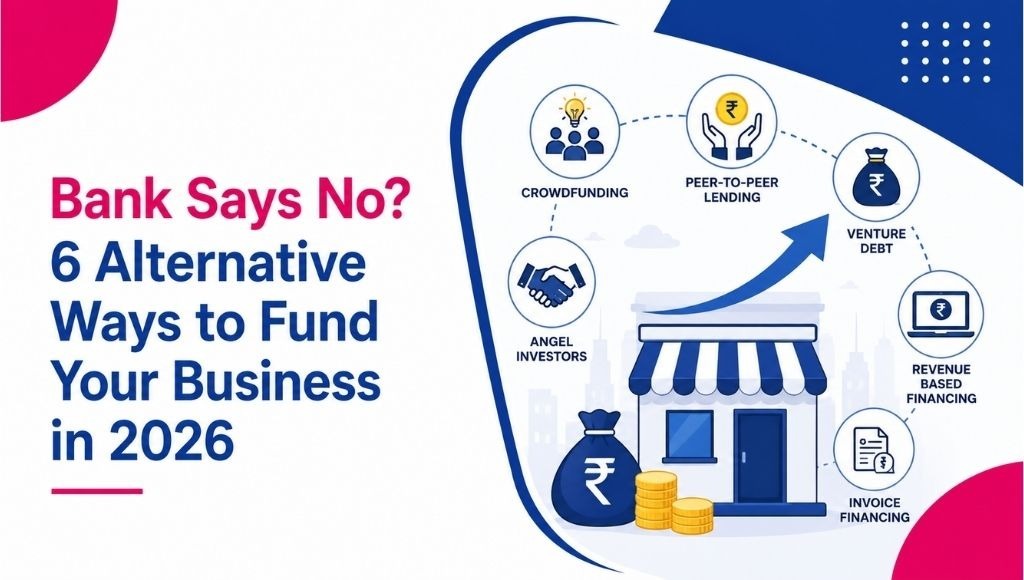
6 Alternative Ways to Fund Your Business in 2026
1. NBFC and Fintech Lenders
Non-banking financial companies and fintech lenders have become one of the fastest-growing funding sources for small businesses that traditional banks turn away. These lenders typically rely more on real-time bank statement analysis and transaction patterns than on a static credit score, which speeds up both approval and disbursal. A business owner searching for a business loan in Ahmedabad today will find a growing number of NBFC branches and app-based lenders offering faster turnaround than conventional banks.
2. Invoice and Bill Discounting
For businesses waiting on unpaid invoices from clients, invoice discounting converts that outstanding revenue into immediate working capital. A lender advances a percentage of the invoice value upfront and collects repayment once the client pays. This option works particularly well for B2B businesses with reliable, established clients but slow payment cycles.
3. Merchant Cash Advance and Revenue-Based Financing
Rather than a fixed loan amount and repayment schedule, this model ties repayment to a percentage of daily or monthly revenue. Payments naturally shrink during slower periods and rise during strong months, which reduces cash flow pressure compared to a fixed EMI structure.
- No fixed monthly payment regardless of business performance
- Faster approval than traditional term loans
- Best suited for businesses with steady card or digital payment volume
Must Read: How to Get a Business Loan with a Low Credit Score
4. Peer-to-Peer Lending and Crowdfunding
Peer-to-peer platforms connect individual investors directly with borrowers, often approving applications that traditional underwriting would reject. Crowdfunding, meanwhile, works well for product-based businesses that can pre-sell inventory or offer early access in exchange for funding. Neither option requires the same collateral or credit thresholds as a conventional bank loan, though both typically involve smaller amounts than a term loan.
5. Loan Against Property or Business Assets
Businesses with existing property, equipment, or inventory can use those assets as collateral for a secured loan, often unlocking better interest rates than unsecured alternatives. Because the lender’s risk is reduced by the underlying asset, approval odds improve even for applicants with a weaker credit history.
6. Personal Loan for Business Needs
When a formal business loan is not immediately available, some owners turn to personal financing to cover short-term gaps. A personal loan in Ahmedabad can sometimes be approved faster than a business loan, since underwriting is based on individual income and credit history rather than business financials. This route works best for smaller funding needs, since interest rates on personal loans are usually higher than secured business financing, and mixing personal and business debt should be approached carefully.
Working with a Local Business Loan Service Provider
Navigating multiple lender types can be time-consuming, especially for a first-time applicant unfamiliar with local documentation requirements. A business loan service provider in Ahmedabad can help compare NBFC, fintech, and bank options side by side, matching the right lender to a business’s specific profile rather than relying on trial and error across multiple applications. This is particularly useful for businesses that have already faced one rejection, since a service provider can often identify the exact factor that triggered the denial and target lenders whose criteria better match the business’s current financials.
How to Choose the Right Alternative for Your Business
- Match the funding type to the need: short-term cash flow gaps suit revenue-based financing, while asset purchases suit secured loans
- Compare total repayment cost, not just approval speed, since faster funding often comes with a higher effective interest rate
- Check documentation requirements early, since NBFCs and fintech lenders often require less paperwork than traditional banks
- Avoid stacking too many funding sources at once, which can strain cash flow and complicate future loan applications
Frequently Asked Questions
Is it harder to get approved after one bank rejection?
Not necessarily. Denial reasons vary by lender, and a business rejected by one bank for insufficient collateral, for example, may be approved elsewhere through an unsecured or revenue-based option that does not weigh collateral the same way.
Are NBFC loans more expensive than bank loans?
Often slightly, yes, since NBFCs take on more risk by approving applicants that banks decline. However, faster disbursal and more flexible documentation can offset the higher rate for businesses that need capital quickly.
Should I use a personal loan to fund my business?
It depends on the amount needed and the urgency. Personal loans can be faster to secure for smaller amounts, but business-specific financing usually offers better terms for larger, longer-term funding needs.
Conclusion
A bank rejection is a common experience, not a dead end. From NBFC and fintech lenders to invoice discounting, revenue-based financing, and secured loans against business assets, today’s funding landscape offers far more flexibility than a single conventional loan product. Comparing options carefully, and getting local guidance where needed, gives businesses a realistic path to the capital they need in 2026.
Suggested Sources for Citation
- Crestmont Capital, Business Loan Denial Rates: Top Reasons and Statistics (2026) – crestmontcapital.com
- Crestmont Capital, Business Loan Rejection Statistics: What Happens After a Denial? – crestmontcapital.com
- ProfileTree, Small Business Loan Statistics: Approval Rates, Trends and Data – profiletree.com
- PassiveSecrets, Business Loan Statistics 2026: 80+ Facts & Trends on Lending – passivesecrets.com