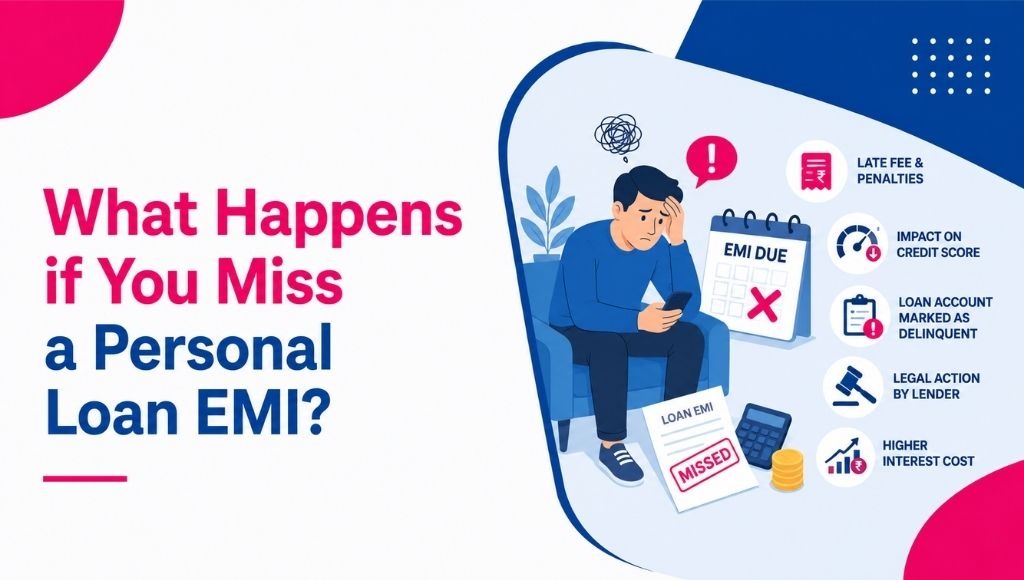
Managing loan repayments is a responsibility that millions of Indians navigate every month. According to the Reserve Bank of India, personal loan disbursements have grown significantly in recent years, with outstanding credit crossing ₹13 lakh crore in 2024, reflecting just how widely these loans are used for everything from medical emergencies to home renovations. Yet, despite best intentions, life can be unpredictable. Job loss, unexpected expenses, or simple oversight can cause a borrower to miss an EMI.
If you have taken a personal loan in Ahmedabad or anywhere else in India, understanding what happens when an EMI is missed, and how to respond to it, is critical. This article covers the immediate consequences, the impact on your credit score, what happens with repeated defaults, and the steps you should take to protect yourself.
What Is a Personal Loan EMI?
Understanding EMI Components
A personal loan EMI (Equated Monthly Instalment) is the fixed amount you repay to your lender each month until the loan is fully paid. Every EMI consists of:
- Principal amount: The portion of the original loan being repaid
- Interest component: The lender’s charge for providing the loan
- Loan tenure: The total period over which repayments are spread
The ratio of principal to interest shifts over time. In the early months, interest makes up a larger share. As you progress through repayments, more of your EMI goes toward reducing the principal.
Why Timely EMI Payments Matter
Paying your EMI on time every month is not just a financial obligation but a habit that builds long-term financial health. Here is why it matters:
- It maintains your financial discipline and helps you stay debt-free on schedule
- It protects you from penalty charges that add to your overall loan cost
- It preserves your creditworthiness, keeping your CIBIL score healthy for future borrowing needs
What Happens Immediately After You Miss a Personal Loan EMI?
Late Payment Fees and Penalties
The moment an EMI is missed, most lenders impose a late payment penalty. This typically ranges between 1% to 3% of the overdue EMI amount per month, depending on the lender’s terms. These charges are added to your outstanding balance and can accumulate quickly if not cleared promptly.
Reminder Calls, Emails, and SMS Notifications
Within a day or two of a missed payment, borrowers usually receive communication from the lender. This may include:
- Automated SMS alerts and emails about the overdue amount
- Follow-up calls from the lender’s customer service team
- Information about any grace period available (usually 3 to 7 days, depending on the lender’s policy)
If you are availing a personal loan service in Ahmedabad, it is advisable to check whether your lender provides a grace period before penalties are officially applied.
Auto-Debit Failure Consequences
If you have set up an ECS or NACH auto-debit mandate and your account lacks sufficient funds:
- Your bank will levy a cheque or ECS bounce charge, typically between ₹300 and ₹500 per instance
- The lender may also impose a separate insufficient balance or failed debit penalty
- Repeated bounce charges can significantly inflate your total repayment cost
How Does Missing an EMI Affect Your Credit Score?
Does One Missed EMI Impact Your Credit Score?
Yes, even a single missed EMI can negatively affect your credit score, though the severity depends on how long the payment remains overdue. A delay of 30 days or more is typically reported to credit bureaus.
How Lenders Report Missed Payments to Credit Bureaus
Lenders in India report borrower repayment behaviour to credit bureaus such as CIBIL, Experian, and Equifax on a monthly basis. Once a missed payment is reported:
- Your credit score can drop by 50 to 100 points or more depending on your existing score
- The missed payment is recorded in your credit history for up to 7 years
- Future lenders can see this information when evaluating your loan application
Long-Term Impact on Future Borrowing
A damaged credit score creates a ripple effect across your financial life:
- New loan applications may be rejected outright
- Lenders who do approve your request may charge significantly higher interest rates
- Your eligible credit limits on credit cards and loans may be reduced
Also Read: How to Apply for a Personal Loan in Ahmedabad
What Happens If You Miss Multiple Personal Loan EMIs?
Loan Account Becomes Delinquent
As missed payments pile up, your loan account moves through stages of delinquency:
- 30-day overdue: First formal alert stage, penalties begin
- 60-day overdue: Increased collection activity begins
- 90-day overdue: Severe credit score damage and escalation by lender
Loan Classified as Non-Performing Asset (NPA)
If an EMI remains unpaid for 90 days or more, the loan is classified as a Non-Performing Asset (NPA) by the lender, as per RBI guidelines. This classification signals serious default and triggers aggressive recovery measures. It also makes it extremely difficult to obtain any form of credit in the future.
Increased Collection Activities
At this stage, borrowers may experience:
- Frequent recovery calls from the lender’s collections team
- Involvement of a third-party collection agency
- Formal legal notices demanding repayment
Can Missing a Personal Loan EMI Lead to Legal Action?
When Do Lenders Initiate Legal Proceedings?
Lenders generally resort to legal action only after multiple follow-up attempts have failed. This typically happens after 6 months or more of consistent non-payment. The lender may file a case in a civil court or approach a debt recovery tribunal (DRT) for higher loan amounts.
Borrower’s Rights During Recovery
Even during recovery, borrowers have rights:
- Collection agents cannot visit your home between 7 PM and 7 AM
- Lenders must follow RBI’s Fair Practices Code for debt recovery
- You have the right to receive a written notice before any legal action is initiated
- Harassment, public shaming, or intimidation by recovery agents is illegal
What Should You Do If You Miss a Personal Loan EMI?
Contact Your Lender Immediately
The single most important step is to reach out to your lender as soon as you realise a payment has been missed. Most lenders are more cooperative when borrowers are proactive and transparent about financial difficulties.
Clear Outstanding Dues Quickly
- Pay the overdue EMI along with applicable late payment penalties at the earliest
- If possible, set up a new auto-debit instruction to prevent future failures
Request Loan Restructuring or EMI Rescheduling
If financial stress is likely to continue, you can formally request:
- An extension of your loan tenure to reduce monthly EMI burden
- A temporary moratorium on payments, subject to lender approval
Consider Balance Transfer Options
If your current lender’s terms are too burdensome, refinancing with another lender at a lower interest rate could reduce your EMI and ease repayment pressure.
Key Takeaways
- Missing a personal loan EMI leads to late fees, bounce charges, and immediate credit score damage
- Repeated defaults can result in NPA classification, collection agency involvement, and legal action
- Contacting your lender early and honestly gives you the best chance of finding a manageable solution
- Financial planning, maintaining an emergency fund, and using auto-debit instructions help avoid missed EMIs altogether