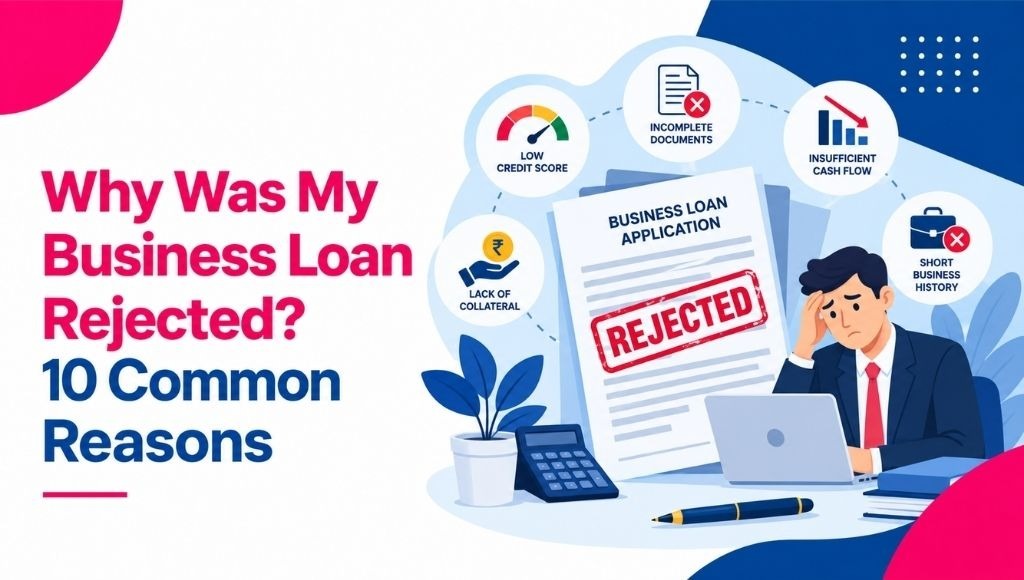
Getting a “loan rejected” notification is frustrating, especially when your business genuinely needs the funds to grow, manage cash flow, or buy equipment. It can feel like a setback that puts your plans on hold, but in most cases, rejection isn’t about your business being unworthy of credit, it’s about one or two specific gaps in your profile or paperwork that a lender’s risk model flagged. The good news is that most rejections come down to a handful of predictable, fixable issues not bad luck.
In short: lenders reject business loan applications mainly due to a low credit score, incomplete documentation, insufficient income proof, high existing debt, an unstable business vintage, or errors in the application itself. Once you know the specific reason, you can correct it and reapply with a much stronger case. Understanding the “why” behind a rejection is the first step toward turning your next application into an approval.
If you’re applying for a business loan in Ahmedabad, understanding these ten common rejection reasons will help you prepare a cleaner, faster, and more successful application.
1. Low or Poor Credit (CIBIL) Score
Your CIBIL score is usually the first thing a lender checks. Most banks and NBFCs prefer a score of 700 and above for business loans, while some MSME-focused lenders may consider scores between 650–685, though approval becomes far less likely below 650. Minimum score requirements can also vary between lenders depending on the loan type, amount, and tenure.
Common causes of a low score:
- Missed EMIs or credit card payments
- High credit utilization
- Frequent loan enquiries in a short period
- Errors in your credit report
Fix: Check your credit report at least three months before applying, clear outstanding dues, and dispute any inaccuracies.
2. Incomplete or Incorrect Documentation
Even a financially strong business can get rejected simply because paperwork was missing, mismatched, or outdated. Lenders typically require KYC documents, business registration proof, GST returns, bank statements, and income tax filings and any inconsistency between these documents raises red flags.
Fix: Keep a checklist of required documents and ensure names, addresses, and financial figures match across all of them.
3. Insufficient or Unstable Business Income
Lenders want assurance that your business generates enough consistent revenue to comfortably repay the loan. If your income fluctuates heavily month to month, or your recent financials show a decline, this can trigger a rejection. Seasonal businesses, in particular, often face closer scrutiny because their bank statements show sharp highs and lows that make average monthly income harder to assess.
Fix: Maintain updated financial statements and, if possible, apply during a period of stable or growing revenue. If your business is seasonal, be ready to explain the pattern with supporting data, such as multi-year statements, so the lender sees the full picture rather than a single low month.
4. High Existing Debt-to-Income Ratio
If a large portion of your current income is already going toward repaying other loans, lenders may see the new loan as an added risk. This is one of the most overlooked reasons applications get declined.
Fix: Try to close smaller existing loans before applying, or apply for a lower loan amount that fits your repayment capacity.
5. Short Business Vintage
Most lenders prefer businesses that have been operational for at least 1–3 years, as this history helps them assess stability and cash flow patterns. Newer businesses are often seen as higher risk.
Fix: If your business is new, consider a co-applicant, collateral, or a government-backed scheme designed for early-stage enterprises.
6. Lack of Collateral or Security (for Secured Loans)
For secured business loans, insufficient or unclear collateral documentation can lead to rejection. Property disputes, unclear titles, or undervalued assets are common issues.
Fix: Get your collateral documents verified and valued in advance, and ensure there are no legal encumbrances.
7. Errors or Inconsistencies in the Application Form
Small mistakes, a wrong PAN number, mismatched business name, or incorrect turnover figures can lead to automatic rejection during the verification stage. This is one of the common mistakes small business owners make when applying for a loan, and it’s entirely avoidable with careful review.
Fix: Double-check every field before submission, and where possible, have a professional review the form.
8. No Udyam/MSME Registration
Many lenders offer better terms and faster approvals to businesses registered under the government’s Udyam (MSME) framework, the official government platform for MSME registration in India. Not having this registration can put you at a disadvantage, especially with priority-sector or subsidized loan schemes.
Fix: Register your business on the official Udyam portal. It’s free and can strengthen your loan profile.
9. Overstated Loan Requirement
Requesting a loan amount that doesn’t align with your business’s turnover, assets, or repayment capacity is a common reason for rejection. Lenders calculate eligibility based on financial ratios, and an unrealistic task signals poor financial planning. Asking for significantly more than your business can service, even with strong intentions, often does more harm to your application than a smaller, well-justified request.
Fix: Use an eligibility calculator or consult a loan advisor to determine a realistic loan amount before applying. It often helps to break a larger funding need into phases, requesting only what your current financials can comfortably support.
10. Applying with the Wrong Lender or Loan Product
Not every lender suits every business. A lender specializing in large corporate loans may not be the right fit for a small trader, and vice versa. Mismatched applications often get rejected simply because the business profile doesn’t fit the lender’s risk criteria.
Fix: Research lenders that specifically cater to your business size, sector, and loan amount or work with experienced business loan consultants in Ahmedabad who understand which lenders are the right match for your profile.
How to Improve Your Chances Before Reapplying
- Review and improve your credit score
- Organize and verify all documents in advance
- Maintain clean, consistent bank statements
- Register under Udyam/MSME if eligible
- Apply for a realistic loan amount
- Choose a lender suited to your business type
A rejected application isn’t the end of the road, it’s usually a sign that one or two specific factors need attention before your next attempt.
Get Expert Help With Your Business Loan Application
Navigating lender requirements, documentation, and eligibility criteria can be time-consuming, especially when you’re focused on running your business. Working with experienced business loan consultants in Ahmedabad can help you identify the right lender, prepare a complete application, and avoid the common mistakes that lead to rejection. Explore business loan options and get personalized guidance today to move from rejection to approval with confidence.
Frequently Asked Questions
1. What credit score is needed to avoid business loan rejection?
Most lenders prefer a CIBIL score of 700 or above, though some MSME lenders accept scores in the 650–685 range with additional scrutiny of income and repayment capacity.
2. Can a new business get a loan without a credit history?
Yes, though it’s harder. Newer businesses can improve approval chances through collateral, a co-applicant with good credit, or government-backed MSME loan schemes.
3. Does applying to multiple lenders at once hurt my chances?
Yes. Multiple loan enquiries in a short span can lower your credit score and make lenders view you as high-risk, so it’s better to apply selectively after checking eligibility.
4. How long should I wait before reapplying after a rejection?
It’s generally advisable to wait at least 3–6 months, using that time to fix the specific issue that caused the rejection, such as improving credit score or organizing documents.
5. Is Udyam registration mandatory for a business loan?
It’s not mandatory for all loans, but it’s highly recommended, as it can improve eligibility for MSME-focused schemes and priority-sector lending benefits.