Cash flow, not lack of profit, is what actually sinks most small businesses. Research cited by Business Insider found that 82% of small businesses that fail point to cash flow problems as a key cause, and separate Federal Reserve survey data shows 51% of small businesses cite uneven cash flow as a recurring financial challenge, with 34% specifically struggling to make payments on existing debt. The JPMorgan Chase Institute has found that the median small business holds only about 27 days of cash buffer, which means a single missed payment or delayed invoice can quickly turn a manageable loan into a serious strain. The good news is that repayment stress is rarely random. It usually follows a handful of predictable patterns, and a few structural habits can prevent a loan from ever becoming the reason a business struggles.
Why Loan Repayment Becomes a Cash Flow Problem
A loan itself is not usually what breaks a business. The mismatch between when money comes in and when it has to go out is the real culprit.
Common Triggers Behind Repayment Stress
- Seasonal revenue dips that do not align with a fixed monthly EMI schedule
- Rapid growth that consumes working capital faster than new revenue replaces it
- Rising costs of goods, wages, or rent eating into the margin set aside for debt payments
- Customers paying late, leaving a gap between invoicing and actual cash in hand
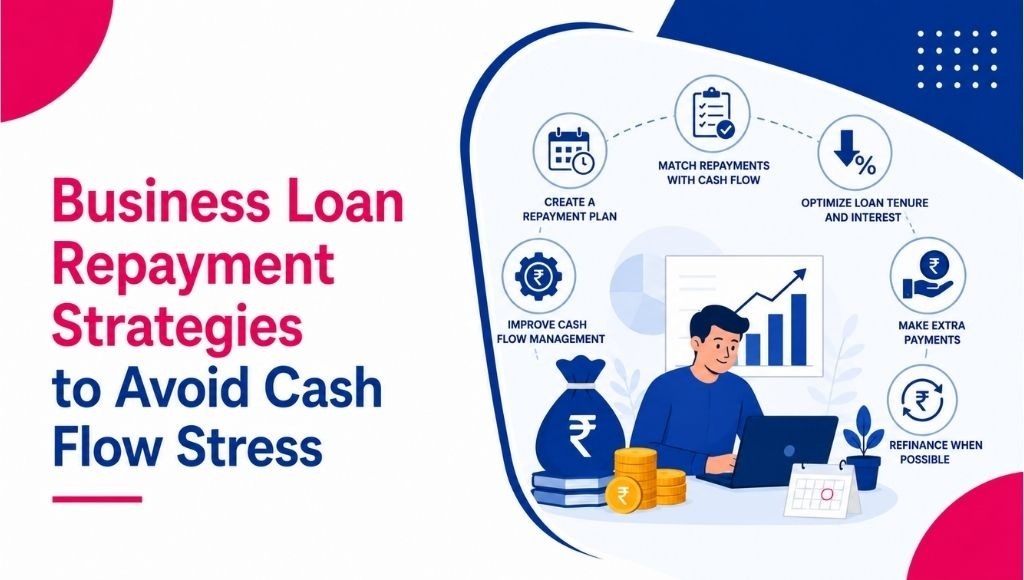
Step 1: Match Your Repayment Schedule to Your Revenue Cycle
One of the most overlooked repayment strategies is simply choosing loan terms that fit how money actually moves through the business, rather than accepting whatever schedule a lender defaults to.
- Businesses with seasonal income should look for step-up or flexible EMI structures rather than a flat monthly payment
- A business loan EMI calculator can help model different repayment scenarios before signing, showing exactly how tenure and interest rate changes affect monthly cash outflow
- Where possible, align due dates with predictable cash inflows, such as right after a typical payment cycle from major clients
Step 2: Build a Cash Buffer Before You Need It
Given that the median small business runs on less than a month of cash reserve, even a small buffer meaningfully changes how much breathing room a business has when repayment pressure builds.
Practical Ways to Build a Buffer
- Set aside a fixed percentage of monthly revenue into a separate reserve account, even if it starts small
- Treat loan repayment as a fixed cost in monthly budgeting, not something paid from whatever is left over
- Avoid drawing the buffer down for non-essential expenses, since its entire value is in staying untouched until genuinely needed
Step 3: Use a Working Capital Loan to Smooth Short-Term Gaps
When a temporary gap opens up between expenses and incoming revenue, taking on the wrong type of financing can make repayment stress worse instead of better. A properly structured working capital loan is designed specifically to bridge these short-term timing gaps without disrupting the repayment schedule on longer-term business debt.
- Working capital financing typically carries shorter terms than a standard business loan, matching the temporary nature of the gap
- Using it to cover a specific, identifiable shortfall keeps repayment obligations predictable rather than compounding
- Avoid using working capital financing to cover recurring shortfalls, since that usually signals a deeper pricing or cost problem rather than a timing issue
Step 4: Refinance or Renegotiate Before Missing a Payment
Many business owners wait until they have already missed a payment before reaching out to their lender, which is precisely the wrong order of operations. Lenders are generally far more willing to adjust terms proactively than after a default has already occurred.
- Reach out early if a temporary cash flow issue is visible on the horizon, rather than waiting for it to arrive
- Ask directly about restructuring options, including extending tenure to lower the EMI or temporarily switching to interest-only payments
- If your current loan carries a high interest rate relative to today’s market, explore whether refinancing into better terms makes sense before repayment pressure builds further
Step 5: Separate Business and Personal Cash Flow Completely
Mixing business and personal finances is one of the fastest ways to lose visibility into actual repayment capacity, since expenses blur together and it becomes difficult to see exactly how much cash the business itself is generating.
- Maintain a dedicated business account solely for revenue, expenses, and loan repayments
- Pay yourself a fixed, predictable salary rather than drawing irregular amounts as needed
- Review business-only cash flow statements monthly, separate from personal finances entirely
Cash Flow Management Habits That Prevent Repayment Stress
Strong cash flow management is less about a single decision and more about consistent, boring habits repeated every month.
- Forecast cash flow at least 60 to 90 days ahead, updating it as new information comes in
- Invoice promptly and follow up on overdue payments quickly rather than letting them age
- Negotiate longer payment terms with suppliers where possible, to reduce timing mismatches
- Review loan terms annually to confirm they still fit the business’s current revenue pattern
Warning Signs Repayment Stress Is Building
Recognizing early warning signs gives a business time to act before repayment becomes genuinely difficult.
- Increasingly relying on short-term credit or credit cards to cover routine operating expenses
- Consistently paying loan EMIs on the very last permitted day rather than comfortably ahead of time
- Delaying payments to suppliers to free up cash for loan repayment
- Watching the cash buffer shrink month over month without a clear plan to rebuild it
If several of these signs are present, it is worth revisiting the original loan structure altogether. Many of the same issues that cause repayment stress are the same ones covered in our related guide on common mistakes small business owners make when applying for a loan, since a poorly structured loan at the outset often surfaces as a cash flow problem later.
Frequently Asked Questions
What is the best way to avoid cash flow stress from a business loan?
Matching the repayment schedule to your actual revenue cycle, keeping a cash reserve, and communicating with your lender early if a shortfall is coming are the three habits that prevent most repayment stress before it starts.
Should I take a new loan to cover an existing loan’s EMI?
Generally, no. Using new debt to cover an existing repayment usually signals a deeper cash flow issue that needs to be addressed directly, rather than papered over with additional borrowing.
When should I contact my lender about repayment difficulty?
As early as possible, ideally as soon as a potential shortfall becomes visible, rather than waiting until a payment has already been missed. Lenders have far more flexibility to help proactively than after a default appears on record.
Building a Repayment Plan That Actually Holds Up
A repayment plan that survives real-world cash flow variability usually combines several of the strategies above rather than relying on just one. Matching EMI structure to revenue timing, keeping even a modest reserve, and staying in regular contact with your lender collectively reduce the odds that a single slow month turns into a genuine crisis. Businesses that treat these as ongoing habits, not one-time fixes, tend to handle repayment far more comfortably than those that only think about it once stress has already set in.
Conclusion
Business loan repayment stress rarely comes out of nowhere. It builds gradually through mismatched schedules, thin cash buffers, and delayed conversations with lenders. Structuring repayment around actual revenue timing, using short-term financing tools like a working capital loan for genuine gaps, and reaching out proactively when trouble is visible on the horizon are the habits that consistently separate businesses that manage debt comfortably from those that end up in crisis.
References
- SMBcompass, 82% of Small Businesses Fail from Cash Flow: The Data
- Federal Reserve Banks, 2026 Report on Employer Firms: Findings from the 2025 Small Business Credit Survey
- The Kaplan Group, 51 Small Business Cash Flow Statistics and Financing Pain Points
- Fora Financial, Small Business Lending Statistics and Trends for 2026