A low credit score changes the terms of a personal loan far more than it closes the door on one. Data from Credible shows borrowers with excellent credit, meaning FICO scores of 800 or higher, have close to a 90% chance of approval, while those below 580 see approval odds fall under 1% through the same marketplace. Yet many lenders still start approving applicants at a credit score around 580, according to LendingTree data, and options expand further once income, employment history, and existing debt are factored in alongside the score itself. The tradeoff is cost. Borrowers with poor credit typically see APRs climb toward 30% to 36%, compared to rates near 7% to 11% for excellent credit borrowers on the same loan amount. This guide breaks down what realistic approval looks like with a low score, which lenders are worth exploring, and how to strengthen an application before submitting it.
What Counts as a Low Credit Score for a Personal Loan
There is no single universal cutoff, since every lender sets its own criteria, but broad tiers help set expectations before applying.
Typical Credit Score Bands
- Excellent credit: 740 and above, qualifying for the lowest advertised rates
- Good credit: 670 to 739, still competitive with most lenders
- Fair credit: 580 to 669, the range where more lenders begin declining or pricing in higher risk
- Poor credit: below 580, where approval depends heavily on income and alternative underwriting data rather than score alone
Why Credit Score Affects Approval and Pricing So Heavily
Lenders use credit score as a quick proxy for repayment risk, and the pricing gap across score bands is significant. A borrower with a 700 score might see an APR near 12%, while a borrower with a sub-580 score looking at the identical loan amount could see rates rocket toward the legal maximum of 36% in most states. This is why comparing the total cost of the loan, not just whether an application gets approved, matters just as much as the approval decision itself.
Steps to Get Approved with a Low Credit Score
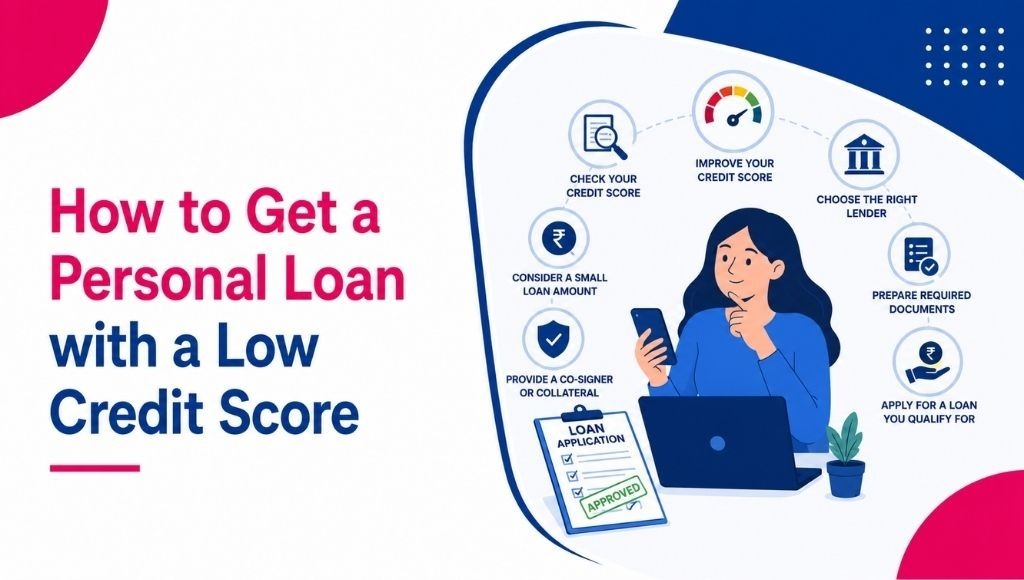
Even without a strong credit history, several concrete steps can meaningfully improve approval odds and the rate offered.
Strengthen Your Application Before Submitting
- Pay down existing revolving balances to lower credit utilization, since this is one of the fastest ways to improve a score before applying
- Correct any errors on your credit report, since mistakes are more common than most borrowers assume
- Gather proof of stable income and employment, since lenders weigh this heavily alongside score
- Avoid applying to multiple lenders in a short window, since repeated hard inquiries can further lower your score
Consider a Co-Signer or Collateral
- Adding a co-signer with stronger credit can improve both approval odds and the rate offered
- A secured personal loan, backed by a savings account, vehicle, or other asset, often qualifies for better terms than an unsecured loan with the same credit profile
- Some lenders specifically design products around collateral for applicants who would not otherwise qualify
Lenders and Loan Types Worth Exploring
Not every lender treats a low score the same way, and some categories are built specifically for this segment of borrowers.
- Credit unions: Often more flexible than large banks, particularly federal credit unions, which cap APRs lower than many online lenders
- Online lenders built for bad credit: Several platforms accept scores as low as 300 to 580, relying more heavily on income and employment data than score alone
- Peer-to-peer lending platforms: Connect individual investors directly with borrowers, sometimes approving applications a traditional bank would decline
For borrowers exploring their options locally, working with an established personal loan service provider in Ahmedabad can help compare lenders side by side rather than applying blind to platforms with mismatched requirements.
Personal Loan vs Business Loan for Bad Credit
Borrowers sometimes assume a personal loan is always the faster or easier route compared to business financing, but this depends heavily on the intended use and the applicant’s overall financial picture. Reviewing the differences covered in our guide on choosing between a business loan and personal loan can help clarify which option actually fits a specific borrowing need, especially for self-employed applicants whose income documentation looks different from a salaried employee’s.
What Happens If You Miss a Payment
Understanding the downside of missing a repayment matters just as much as understanding approval odds, particularly for borrowers already managing a lower credit score. A single missed payment can trigger late fees, a further drop in credit score, and in some cases acceleration clauses that make the remaining balance due immediately. For a full breakdown of what actually happens and how to recover, see our detailed explainer on what happens if you miss a personal loan EMI.
Red Flags to Watch for When Borrowing with Bad Credit
Borrowers with limited options sometimes end up targeted by predatory lending practices, so a few warning signs are worth watching for closely.
- Guaranteed approval promises before any credit or income check has taken place
- Upfront fees required before funds are disbursed
- Pressure to sign quickly without time to review full loan terms
- APRs significantly above the typical range for your credit tier without a clear explanation
Frequently Asked Questions
Can I get a personal loan with a credit score below 580?
Yes, though options narrow considerably. Some lenders have no formal minimum score and instead weigh income, employment history, and existing debt more heavily, though rates will generally be at the higher end of the market.
Will applying for multiple personal loans hurt my credit score?
Rate shopping within a short window, typically 14 to 45 days depending on the scoring model, is often treated as a single inquiry. Spreading applications out over a longer period can cause more noticeable score impact.
Is a secured personal loan easier to get with bad credit?
Generally yes. Offering collateral reduces the lender’s risk, which can improve both approval odds and the interest rate offered compared to an unsecured loan with the same credit profile.
Final Thoughts
A low credit score narrows the field of lenders willing to work with you, but it rarely eliminates personal loan options entirely. Credit unions, lenders built specifically for bad credit, and secured loan structures all remain realistic paths, and steps like paying down utilization or adding a co-signer can meaningfully shift both approval odds and the rate offered. The most practical approach is comparing total repayment cost across a few realistic options rather than accepting the first offer that comes through.
This article is for general informational purposes only and is not financial advice. Loan terms, credit requirements, and approval criteria vary by lender and change over time, so confirm current requirements directly with any lender before applying.