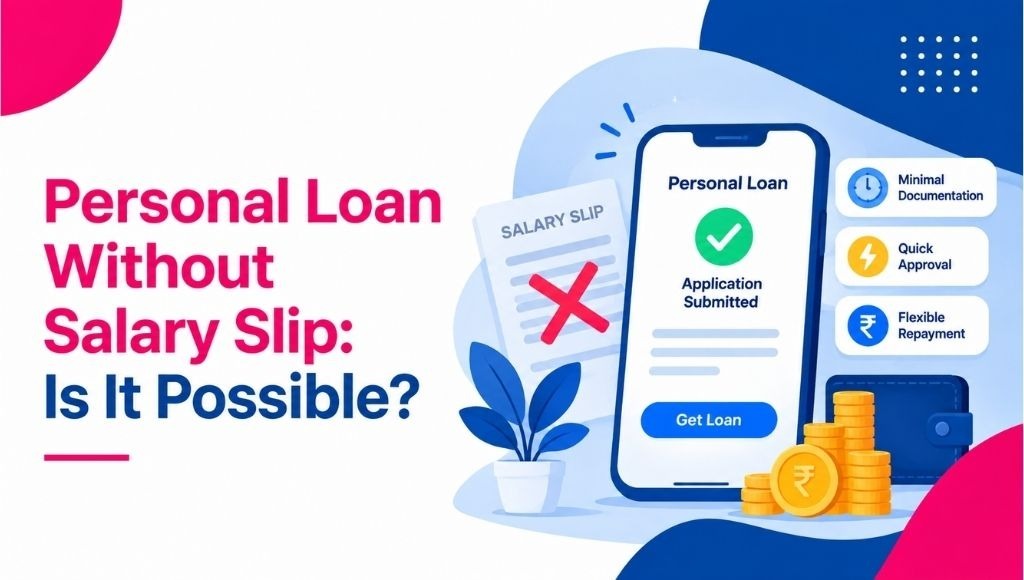
A single missing document has ended more loan conversations than any credit score ever has. “Attach last three months’ salary slips” is where the process stops for tens of millions of Indians who simply do not fit the salaried, monthly-payslip mold that most banks were built around. Loan amounts up to ₹10 lakh remain accessible without a salary slip, though interest rates on these loans range from roughly 12% to 36% per annum depending on income documentation quality and credit score. The reassuring reality is that “without salary slip” does not mean “without income proof,” lenders still need evidence of stable income, they simply accept a different form of it. This guide breaks down exactly which alternatives work, who typically qualifies, and what the tradeoffs look like.
Why Salary Slips Matter to Lenders in the First Place
Banks ask for salary slips for two specific reasons: to verify that income actually exists, and to confirm it is stable enough to support a monthly EMI for the full loan tenure.
What a Salary Slip Actually Proves to a Lender
- Confirmation of a consistent, recurring monthly income amount
- Evidence of stable employment with a verifiable employer
- A predictable basis for calculating how much EMI the applicant can realistically afford
- Without it, lenders cannot complete this verification through their standard, automated process
Who Typically Needs This Alternative Path
Several borrower categories run into the same wall when a lender’s application defaults to requiring a salary slip.
- Freelancers and independent consultants billing clients irregularly rather than receiving a fixed monthly paycheck
- Self-employed business owners and proprietors whose income flows through business accounts rather than personal payroll
- Gig economy workers earning through platform-based, variable income streams
- Retired individuals living on pension income rather than active employment
- Homemakers managing household finances through rental income, fixed deposits, or other non-employment sources
What Lenders Accept Instead of a Salary Slip
Rather than a single salary slip, lenders piece together a picture of income stability from several alternative documents, often in combination.
- Bank statements, typically covering six to twelve months, showing regular income credits into the account
- Income Tax Returns (ITR), usually for the last two to three years, demonstrating consistent reported income over time
- GST returns, particularly relevant for self-employed applicants and small business owners
- Rental income proof, supported by a registered lease agreement and rent receipts
- Pension payment orders, for retired applicants relying on pension income rather than active employment
- Business account statements, for proprietors whose income runs primarily through a business entity rather than a personal account
How Credit Score Becomes the Primary Trust Signal
When a salary slip is not part of the application, credit score takes on outsized importance, since it becomes the clearest signal a lender has of how reliably an applicant has repaid debt in the past.
- A strong CIBIL score, generally 700 or above, is often required to reassure lenders about repayment capacity without traditional income documentation
- A high score paired with limited income documentation can still result in approval, since consistent repayment history carries significant weight
- Checking your credit score before applying, and correcting any errors, is one of the most useful steps an applicant without a salary slip can take
- The stronger and more consistent the available income evidence, the lower the interest rate a lender is likely to offer
NBFCs and Digital Lenders Offer the Most Flexibility
Traditional banks generally still insist on a salary slip or an equivalent formal income document, but the broader lending landscape has expanded considerably beyond that requirement.
- NBFCs are generally the preferred option for borrowers without salary slips, since their underwriting frameworks are built to weigh bank statements and business documentation more heavily
- Digital-first lenders increasingly use Account Aggregator framework data to assess bank transaction history directly, sometimes requiring minimal or no manual document upload
- Fintech platforms often approve based on spending patterns and transaction history alone, particularly for applicants with strong, consistent bank activity
- Because these loans are unsecured with more limited income verification, interest rates tend to run higher than a comparable salaried applicant would receive from a traditional bank
Secured Options Can Improve Approval Odds
For applicants who own property or other significant assets, a secured loan structure can meaningfully change the approval conversation.
- A loan against property does not require the same income documentation, since the property itself serves as collateral reducing the lender’s risk
- Gold loans offer a similar secured structure, often processed faster and with less scrutiny of income documentation than an unsecured personal loan
- Secured options generally come with lower interest rates than unsecured alternatives, since the lender’s risk exposure is significantly reduced
Applying for an Instant Personal Loan in Ahmedabad Without a Salary Slip
Local lenders familiar with alternative documentation requirements can move an application through underwriting considerably faster than a generic online application built around salaried borrowers. Applicants exploring an instant personal loan in Ahmedabad without a formal salary slip should prepare bank statements and ITR filings in advance, since having documentation ready upfront is often what separates a same-week approval from a drawn-out back-and-forth with a lender.
Working With a Lender That Understands Non-Traditional Income
Not every lender evaluates non-salaried applicants with the same flexibility, which makes choosing the right partner as important as the documentation itself. A personal loan in Ahmedabad sourced through a provider experienced with self-employed and freelance applicants can help match a borrower’s specific income profile to lenders realistically likely to approve, rather than applying broadly to institutions built around a salaried borrower template.
What This Path Typically Costs
Understanding the tradeoffs upfront helps set realistic expectations before applying.
- Interest rates for personal loans without a salary slip commonly range from 12% to 36% per annum, depending heavily on documentation quality and credit score
- Loan amounts up to roughly ₹10 lakh remain accessible through this path, though larger amounts may require stronger supporting documentation
- Processing timelines vary significantly by lender and how complete the applicant’s alternative documentation is at the time of application
- A co-applicant with stronger, verifiable income can sometimes improve both approval odds and the rate offered
Frequently Asked Questions
Can a freelancer get a personal loan without a salary slip in India?
Yes. Freelancers can typically qualify using bank statements, ITR filings, or a strong, consistent transaction history, with several NBFCs and digital lenders specifically built to evaluate this type of non-traditional income.
Is it possible to get a personal loan with no income proof at all?
Generally no, unless a co-applicant with verifiable income is included or the loan is secured against an asset like property or gold. Lenders need some evidence of repayment capacity, even if it is not a formal salary slip.
Do self-employed applicants pay higher interest rates without a salary slip?
Often yes, since the loan is unsecured and income verification is less standardized than for a salaried applicant. A strong credit score and thorough documentation can help narrow this gap considerably.
Steps to Improve Your Chances Without a Salary Slip
- Identify your specific income type first, whether self-employed, freelance, pension, or rental, since the right lender depends on what documentation you actually have
- Check your credit score before applying, since it becomes the primary trust signal in the absence of a salary slip
- Gather six to twelve months of bank statements and recent ITR filings in advance, rather than scrambling once an application is already underway
- Consider a secured option, such as a loan against property, if approval through an unsecured route proves difficult
Conclusion
A personal loan without a salary slip is genuinely possible in 2026, but it requires substituting one form of income proof for another rather than skipping verification altogether. Bank statements, ITR filings, GST returns, and a strong credit score collectively give lenders, particularly NBFCs and digital-first platforms, enough confidence to approve applicants who fall outside the traditional salaried template. Preparing this documentation thoroughly before applying, and choosing a lender genuinely experienced with non-traditional income, consistently produces faster approvals and better terms than applying blind to an institution built for a different kind of borrower.
Sources
- Bajaj Finance, How to Secure a Personal Loan Without a Salary Slip – bajajfinserv.in/personal-loan-without-salary-slip
- FinanceBuddha, Personal Loan Without Income Proof in India 2026: What’s Actually Possible – blog.financebuddha.com/personal-loan-without-income-proof
- FinanceBuddha, Personal Loan Without Salary Slip: How to Apply & What Lenders Accept – blog.financebuddha.com/how-to-apply-personal-loan-without-salary-slip
- TapTap Loans, Personal Loan Without Income Proof in India: 5 Real Paths – taptaploans.in/blog/personal-loan-without-income-proof-india