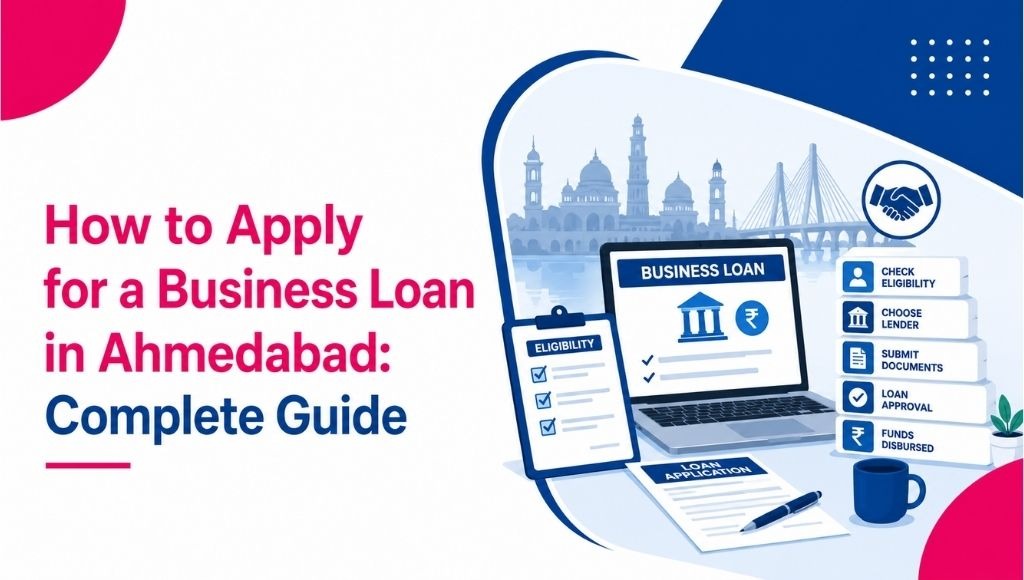
Applying for a business loan involves checking your eligibility, choosing the right loan type, gathering documents, comparing lenders, applying online or offline, going through verification, and finally receiving disbursal. As of mid-2026, business loan interest rates typically range from 11% to 18% per annum, depending on the lender and loan type. This guide reflects publicly available information as of mid-2026 and is not financial advice. Rates, eligibility criteria, and government schemes change frequently, so always verify current terms directly with your bank or NBFC before applying.
Why Ahmedabad Is a Strong Market for Business Loans
Ahmedabad has traditionally been a business hub in Gujarat, one that has nurtured a large number of successful entrepreneurs and growing companies over the decades. That legacy shows up today in the sheer density of lending options available locally. The city has a strong presence of MSME-focused lenders, NBFCs, and PSU bank branches, which gives most business owners searching for a business loan in Ahmedabad several realistic paths to funding rather than a single default option.
Types of Business Loans Available in Ahmedabad
Before comparing lenders, it helps to understand the broad categories on offer:
- Unsecured or collateral-free business loans: no asset pledge required, though eligibility typically needs the business to have been operating for more than six months with a minimum turnover of ₹90,000 in the last three months
- MSME or SME loans: often carry lower rates thanks to government-backed subsidy schemes
- Working capital loans: flexible structures tied directly to the business cycle rather than a fixed term
- Government-backed schemes: covered in detail later in this guide, including MUDRA, CGTMSE, Stand-Up India, and PMEGP
Step-by-Step Process to Apply for a Business Loan in Ahmedabad
Step 1: Check Your Eligibility
Most lenders require applicants to be between 24 and 65 years old, hold Indian citizenship, have a minimum of two years of business vintage, and show an annual turnover of at least ₹6 lakh, though this varies by lender. Minimum salaried income for eligibility usually starts from ₹25,000 per month, while self-employed applicants typically need ₹1 to 2 lakh in annual income. It also helps to check your debt-to-income ratio in advance, since keeping it well below 50% strengthens your eligibility considerably.
Step 2: Decide the Loan Type and Amount You Need
Match the loan type to your actual purpose, whether that’s working capital, expansion, or equipment financing. Loan amounts available in Ahmedabad range widely. Some lenders offer up to ₹90 lakh, with rates starting around 12% per annum for qualifying borrowers.
Step 3: Check If You Qualify for a Government-Backed Scheme First
This is the step most guides skip, and it can meaningfully reduce your borrowing cost. Without Udyam Registration, businesses lose access to MUDRA loans, the CGTMSE guarantee, PMEGP, Stand-Up India, and other government MSME benefits. Registration takes under 30 minutes at udyamregistration.gov.in and is completely free.
A few scheme details worth knowing before you borrow commercially:
- CGTMSE now guarantees collateral-free loans up to ₹10 crore for standard MSEs, covering 75 to 85% of the loan amount, with the Annual Guarantee Fee starting at just 0.37% per annum following an April 2025 revision
- As of RBI’s Master Direction dated February 9, 2026, Scheduled Commercial Banks are mandated not to accept collateral security for MSE loans up to ₹20 lakh
- MUDRA loans cover ₹50,000 to ₹10 lakh with no collateral required, split across three tiers: Shishu, Kishore, and Tarun
Must Read: 6 Mistakes Small Business Owners Make When Applying for a Loan
Step 4: Gather the Required Documents
Have these ready before you start the application to avoid delays:
- KYC documents, meaning identity and address proof for the borrower and all co-borrowers
- PAN card and business proof, such as a business license, ITR, or sales tax certificate
- Last six months’ bank statements for financial evaluation
- Udyam Registration Certificate, mandatory for government scheme benefits
- GST registration certificate, if applicable
Step 5: Compare Lenders and Interest Rates
Rates generally fall between 11% and 18% depending on the lender and loan type. Public sector banks tie their rates to the RBI Repo Rate through the External Benchmark Lending Rate (EBLR), with cash credit currently sitting around 8.55% per annum and above for MSME working capital. If comparing multiple lenders feels overwhelming, many business owners in the city choose to work with business loan consultants in Ahmedabad who can shortlist options based on eligibility and documentation readiness.
| Bank/NBFC Type | Starting Rate | Max Amount | Collateral Required |
| PSU Bank (EBLR-linked) | ~8.55% p.a. | Varies by scheme | Often not required up to ₹20 lakh |
| NBFC (unsecured) | ~12% p.a. | Up to ₹90 lakh | Typically none |
| CGTMSE-backed loan | Lender-dependent | Up to ₹10 crore | Guaranteed, not pledged |
Step 6: Apply Online or Visit a Branch
Most applications ask you to enter your date of birth, PAN number, monthly income, and residential details, then upload supporting documents for verification. Ahmedabad offers both digital-first NBFC routes for faster processing and a strong branch network for PSU banks if you prefer an in-person process.
Step 7: Verification and Approval
Once your application is submitted, the bank or NBFC assesses creditworthiness, business vintage, and repayment capacity. Lenders typically issue fast in-principle approval once documentation is complete and consistent.
Step 8: Loan Disbursal
Some lenders disburse funds within 24 hours of final approval, with the amount credited directly to your business bank account.
Government Loan Schemes Worth Checking Before You Borrow Commercially
Enhanced guarantee coverage now applies to special-category MSEs, including women-led enterprises, widening access beyond standard eligibility criteria. The Union Budget 2026 announced a dedicated ₹10,000 crore growth fund aimed at strengthening MSMEs nationally. This matters because India has over 6.3 crore registered MSMEs, yet only around 16% currently have access to formal credit, which underscores why checking scheme eligibility before applying commercially can save significant interest cost over the life of the loan.
Common Mistakes to Avoid When Applying
- Skipping Udyam Registration before applying, which forfeits access to subsidized schemes
- Applying to multiple lenders simultaneously, which can hurt your credit score through repeated hard inquiries
- Underestimating documentation requirements for turnover or ITR proof
- Not comparing EBLR-linked bank rates against NBFC unsecured rates before committing
FAQ Section
What is the minimum turnover required for a business loan in Ahmedabad? Most unsecured loan products require a minimum turnover of around ₹90,000 in the last three months, though exact thresholds vary by lender and loan type.
Can a startup with no collateral get a business loan in Ahmedabad? Yes, through unsecured business loans or CGTMSE-backed schemes, which guarantee collateral-free loans up to ₹10 crore for eligible MSEs.
What is the current interest rate range for business loans in Ahmedabad? Rates typically range from 11% to 18% per annum as of mid-2026, depending on the lender, loan structure, and whether the loan is secured or unsecured.
Is Udyam Registration mandatory for a business loan? It’s not mandatory for every private lender, but it’s required to access government-backed schemes like MUDRA, CGTMSE, PMEGP, and Stand-Up India.
How long does business loan disbursal take in Ahmedabad? Once approved, some lenders disburse funds within 24 hours, though timelines vary based on documentation completeness and loan type.
Key Takeaways
- Interest rates in Ahmedabad currently range roughly 11 to 18% depending on lender and collateral
- Udyam Registration is the gateway to MUDRA, CGTMSE, and other subsidized schemes, so complete this first
- CGTMSE now covers collateral-free loans up to ₹10 crore at a significantly reduced guarantee fee
- Banks tied to RBI’s repo rate through EBLR often beat NBFC unsecured rates for eligible MSMEs
- Six months of clean bank statements and proper ITR filing meaningfully speed up approval