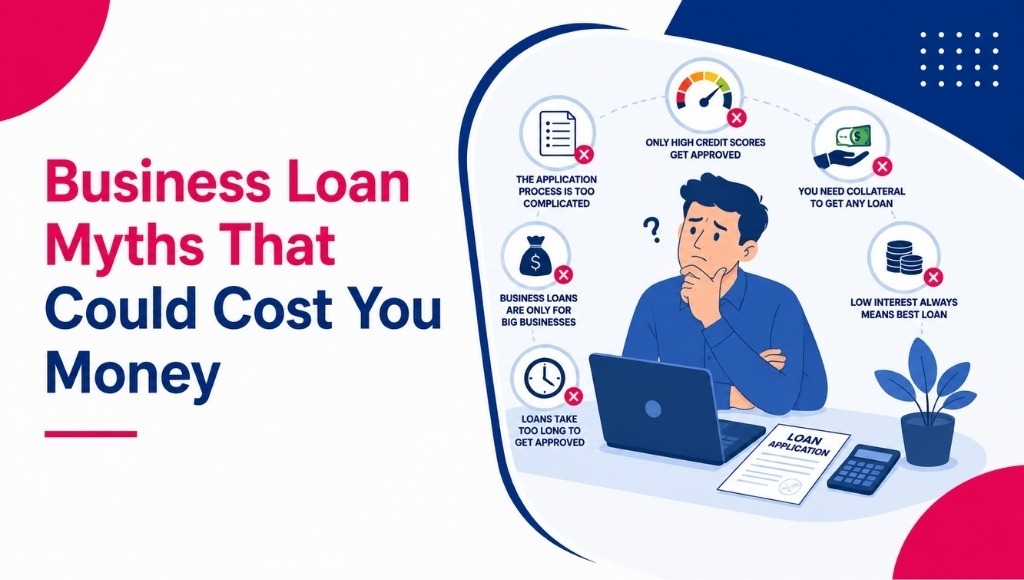
Bad information costs more than a missed opportunity. It costs actual money, in the form of higher rates, rejected applications, and financing decisions made on assumptions that were never true to begin with. Most small business loans are actually issued for amounts under $100,000, despite a widespread belief that lenders are only interested in large-scale financing. Business owners can improve a low credit score by as much as 100 points in as little as six months of consistent, on-time payments, yet many delay applying entirely because they assume their credit is a permanent disqualifier. Believing outdated or simply false ideas about how business lending works can quietly steer an owner toward the wrong product, a worse rate, or a decision to avoid financing altogether when better options were available all along. This guide breaks down the most costly myths still circulating among small business owners and replaces each one with what actually holds true in 2026.
Here’s 8 False Beliefs That Could Cost You Money
Myth 1: The Advertised Interest Rate Is What You’ll Get
Marketing materials for business loans almost always lead with their best-case rate, and many owners assume that number applies broadly across applicants.
What’s Actually True
- Advertised rates typically represent the best-case scenario for the strongest applicants, not a standard offer
- Your actual rate depends on credit score, time in business, annual revenue, and current market conditions
- Getting a real, personalized rate quote before comparing lenders is the only reliable way to know what you’ll actually pay
Myth 2: You Need a Perfect Credit Score to Qualify
This is one of the most damaging misconceptions in small business lending, since it discourages otherwise qualified owners from applying at all.
- Lenders weigh cash flow, time in business, and revenue alongside credit score, not credit score alone
- Alternative lenders routinely approve applicants with less-than-perfect credit that traditional banks would decline
- A credit score can improve meaningfully, sometimes by up to 100 points, within about six months of consistent, on-time payments
Myth 3: Banks Are the Only Real Source of Business Financing
Traditional banks and credit unions still handle a significant share of small business lending, but they are far from the only option available today.
- A wide range of alternative lenders now offer funding in a fraction of the time traditional banks require
- NBFCs and fintech lenders increasingly rely on real-time cash flow data rather than credit score alone
- Owners in India exploring a business loan in Ahmedabad have access to a growing mix of banks, NBFCs, and local lending partners, not a single traditional path
Myth 4: Loans Are Only for Businesses in Trouble
Many owners view borrowing as a last resort, reserved only for businesses struggling to stay afloat. This assumption alone stops healthy, growing businesses from accessing capital that could accelerate expansion.
- Loans are frequently used as growth tools, not just financial rescue measures
- Financing inventory purchases, equipment upgrades, or marketing campaigns is a common and financially sound use of a business loan
- Waiting until a business is in genuine distress to seek financing often results in worse terms than applying while the business is stable
Myth 5: Startups Can Easily Get a Traditional Bank Loan
The word “startup” gets used loosely, but most traditional lenders, including SBA-backed programs, require a business to have been operating for at least a year before considering it a lending candidate.
- Most traditional and SBA lenders expect at least one year of operating history before extending credit
- Early-stage businesses are generally better served by alternative lenders, angel investors, or revenue-based financing until they build a track record
- Once a business has consistent income and a few tax filings behind it, traditional lenders become a realistic option
Also Read: Startup Business Loans: Funding Options for New Entrepreneurs
Myth 6: SBA Loans Are Fully Government-Guaranteed, So Repayment Doesn’t Matter
This misunderstanding can lead borrowers into a genuinely risky financial position, since it is simply not accurate.
- The government guarantee on an SBA loan protects the lender, not the borrower, from default risk
- Borrowers remain fully responsible for repaying the loan regardless of the guarantee structure
- Treating an SBA loan as somehow less serious than conventional debt is a costly misunderstanding that can lead to missed payments and damaged credit
Myth 7: The Loan Application Process Always Takes Too Long
Fear of a slow, painful process leads many owners to delay applying, sometimes for months, while their actual financing needs grow more urgent.
- Fear of a lengthy process is one of the biggest reasons owners avoid exploring financing options altogether
- Simplified SBA application processes now allow borrowers to secure funding in timelines comparable to a conventional loan
- Delaying the application process often means owners fund gaps with high-interest credit cards instead, which usually costs more than a properly structured loan would have
Owners researching a small business loan in Ahmedabad specifically will find that a clear, well-documented application, prepared in advance, moves through underwriting far faster than the vague, unprepared applications that create the slow-process reputation in the first place.
Myth 8: Personal Credit Doesn’t Matter for Business Financing, or It’s the Only Thing That Matters
Both extremes of this belief are misleading, and the truth sits somewhere in between depending on the financing type.
- Personal credit history carries significant weight for term loans and lines of credit from traditional lenders
- Invoice financing, by contrast, is based primarily on the creditworthiness of your customers rather than your own credit profile
- Understanding which financing type weighs which factors prevents owners from either overestimating or dismissing the role personal credit plays
Why These Myths Cost Real Money
Believing any one of these misconceptions in isolation is manageable. Believing several of them together is what tends to produce genuinely costly outcomes.
- Avoiding SBA loans due to guarantee confusion, then paying higher rates through a less favorable product
- Delaying financing out of fear of a slow process, then relying on high-interest credit cards to cover the same gap
- Assuming a perfect credit score is required, then never applying despite qualifying through an alternative lender
- Chasing an advertised rate that was never realistically available, then feeling blindsided by the actual offer
Reviewing common application pitfalls alongside these myths is worthwhile, since many of the same misconceptions show up in our guide on mistakes small business owners make when applying for a loan.
Frequently Asked Questions
Do I need excellent credit to get approved for a business loan?
No. While credit score matters, lenders also weigh cash flow, time in business, and revenue. Many alternative lenders specifically work with applicants who have less-than-perfect credit.
Are SBA loans really guaranteed, meaning I won’t owe anything if I default?
No. The SBA guarantee protects the lender’s risk, not the borrower’s repayment obligation. Borrowers remain fully responsible for repaying an SBA loan under its agreed terms.
Is it true that business loans are only for large amounts of money?
No. Most small business loans are issued for amounts under $100,000, and financing options exist across a wide range of amounts to match different business needs.
How to Avoid Costly Misconceptions Going Forward
- Get a personalized rate quote rather than relying on advertised best-case numbers
- Research alternative lenders alongside traditional banks before assuming you don’t qualify
- Understand which financing type actually weighs personal credit versus business cash flow or customer creditworthiness
- Apply while the business is stable rather than waiting until financing becomes urgent
Conclusion
Business loan myths persist because they sound plausible, not because they are accurate, and believing them can quietly cost thousands in higher rates, missed opportunities, or unnecessary delays. Understanding what actually drives approval decisions, how SBA guarantees really work, and which lenders genuinely fit a business’s current stage puts owners in a far stronger position than relying on secondhand assumptions. The businesses that separate myth from reality before applying consistently secure better terms than those that let outdated beliefs make the decision for them.