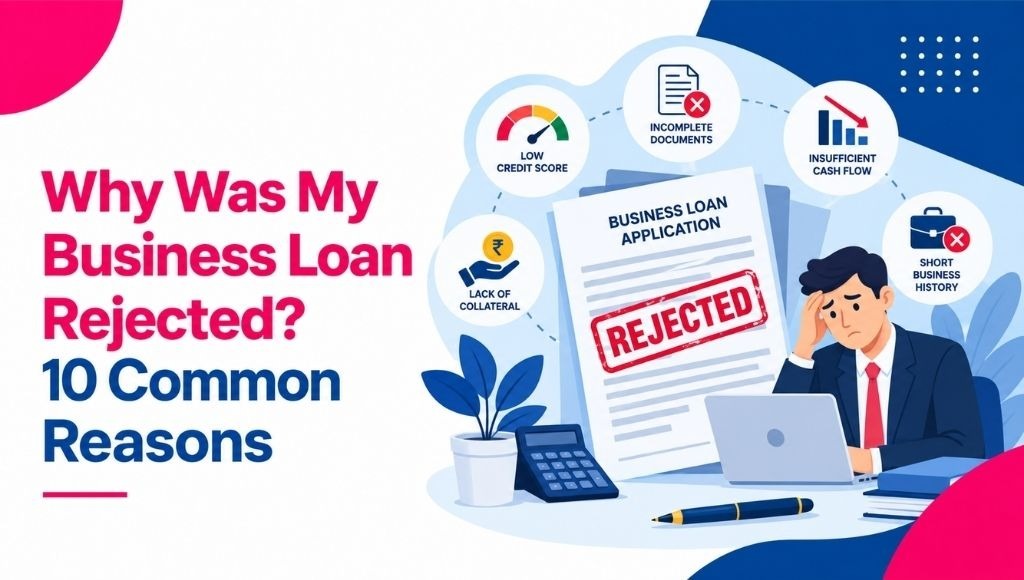
Documentation is the backbone of every successful business loan application. Lenders across India approved over 67% of business loan applications that came with complete and accurate paperwork in 2024, according to industry data from the MSME lending sector. On the other hand, incomplete submissions remain the single most common reason for delays or outright rejections. Whether you are a small business owner seeking working capital or an entrepreneur looking to expand operations, understanding what documents lenders need can save weeks of back-and-forth.
Lenders request specific documents to verify that your business is genuine, your finances are stable, and you have the capacity to repay. Submitting the right paperwork upfront also speeds up the internal processing cycle, which means faster disbursal for you. This 2026 checklist covers every document category a lender is likely to request, organised by type and loan amount, so you can walk into any application fully prepared.
Why Do Lenders Ask for Business Loan Documents?
Verify Business Legitimacy
Before sanctioning any credit, a lender needs to confirm that your business actually exists and is operating legally. Registration documents, trade licences, and incorporation certificates serve as evidence of business existence. Ownership verification is equally important, particularly for partnerships and private limited companies, where multiple stakeholders may be involved.
Assess Financial Health
Documents such as bank statements, financial statements, and GST returns give lenders a clear picture of your business’s financial position. They analyse monthly revenue patterns, evaluate cash flow consistency, and review any existing debt obligations. A business with predictable income and manageable liabilities is considered a safer lending prospect.
Evaluate Repayment Capacity
Beyond raw revenue figures, lenders assess your creditworthiness by looking at how reliably your business generates surplus after meeting its expenses. Business stability indicators such as consistent profit margins and low loan defaults in your credit history directly influence the loan amount and interest rate you are offered.
Meet Regulatory Compliance
All lenders operating in India are required by the Reserve Bank of India to follow Know Your Customer guidelines. KYC documentation ensures that loans are not disbursed to fraudulent entities. Anti-fraud checks through identity and address verification are mandatory steps in every business loan process, regardless of loan size.
Complete Business Loan Document Checklist for 2026
Identity Proof of Business Owner(s)
Accepted Documents: PAN Card, Aadhaar Card, Passport, Voter ID, Driving Licence
Your PAN Card is non-negotiable for any loan application above Rs. 50,000, as it links directly to your tax records. The Aadhaar Card is increasingly accepted as a primary identity document due to its biometric verification capability. Lenders use these documents for identity verification and to run checks against fraud databases maintained by credit bureaus.
Address Proof
Accepted Documents: Aadhaar Card, Utility Bills, Rental Agreement, Passport, Property Tax Receipt
Address proof establishes your residential or business location for communication and verification purposes. Utility bills should not be older than three months. A registered rental agreement is particularly useful if your business premises are leased, as it also partially validates your business address.
Business Registration Documents
The documents required here vary based on your business structure.
Sole Proprietorship: GST Registration certificate, Shop and Establishment Certificate, and Udyam Registration under the MSME portal.
Partnership Firm: The registered Partnership Deed along with the Firm Registration Certificate issued by the Registrar of Firms.
LLP: The LLP Agreement and the Certificate of Incorporation issued by the Ministry of Corporate Affairs.
Private Limited Company: Certificate of Incorporation, Memorandum of Association, and Articles of Association. These three documents collectively define the company’s legal existence, its objectives, and its internal governance structure.
PAN and GST Documents
Required Documents: Business PAN Card, GST Registration Certificate
The Business PAN Card is separate from your personal PAN and is issued specifically in the name of the business entity. Your GST Registration Certificate confirms that your business is registered under the Goods and Services Tax framework, which serves as both a tax compliance indicator and a business legitimacy confirmation. Lenders treat GST-registered businesses as more credible borrowers, particularly for loans above Rs. 10 lakh.
Bank Statements
Documents Required: Last 6 months of bank statements; some lenders may request up to 12 months
Bank statements are among the most closely scrutinised documents in the entire loan file. Lenders examine your monthly cash flow to assess whether your business consistently generates enough revenue to service debt. They also look at your average account balance, the regularity of incoming transactions, and whether any existing loan EMIs are being paid on time. Irregular deposits or frequent overdrafts can raise concerns about business stability.
Income Tax Returns (ITR)
For Business Owners: ITR for the last 2 to 3 financial years, both personal and business
ITR documents give lenders a longitudinal view of your income stability. They use these filings to assess whether your declared income matches the deposits in your bank statements. Consistent year-on-year profitability reflected in your returns significantly strengthens your repayment capacity assessment and overall creditworthiness in the lender’s evaluation.
Financial Statements
Key Documents: Profit and Loss Statement, Balance Sheet, Cash Flow Statement
These are typically prepared by a chartered accountant and cover the last two to three financial years. Lenders look for revenue growth trends, healthy net profit margins, a manageable debt-to-equity ratio, and a positive liquidity position. For loans above Rs. 50 lakh, audited financial statements are almost always mandatory.
GST Returns
Commonly Requested: GSTR-1 and GSTR-3B
GSTR-1 details your outward supplies, while GSTR-3B is your monthly summary return that includes tax liability and input tax credits. Together, these returns help lenders independently verify the revenue figures you have declared in your financial statements. Regular and timely GST filing also reflects positively on your compliance record.
Business Ownership Proof
Accepted Documents: Trade Licence, Business Registration Certificate, Commercial Property Documents, Lease Agreement
For businesses operating from owned premises, a property document establishes both ownership and business location. A lease agreement serves the same purpose for rented spaces. Trade licences issued by local municipal bodies are often requested for retail or service-based businesses as additional proof of ongoing operations.
Existing Loan Details
If your business has any outstanding loans, you will need to provide complete details including outstanding balances, EMI schedules, and loan account statements. This information helps the lender calculate your existing debt obligations and determine how much additional credit your business can safely absorb.
Business Loan Document Checklist by Loan Amount
Loans Up to Rs. 10 Lakhs
For smaller ticket loans, lenders typically require basic KYC documents, the last six months of bank statements, and GST records. Many digital lenders and NBFCs have streamlined this tier significantly, with approvals sometimes possible within 48 to 72 hours.
Loans Between Rs. 10 and Rs. 50 Lakhs
This bracket requires a more detailed review. Expect to submit ITR records for at least two years, detailed financial statements, and full business registration documents. Lenders at this level often conduct a telephonic or in-person verification as well.
Loans Above Rs. 50 Lakhs
High-value loans attract the most rigorous scrutiny. Audited financial statements prepared by a certified auditor are mandatory. You may also need to submit collateral documents if the lender requires security, along with a detailed business plan outlining how the funds will be used and how repayment will be managed.
Conclusion
A well-prepared document file is not just a formality; it is your strongest argument for loan approval. The documents covered in this checklist collectively establish your business identity, demonstrate financial discipline, and prove your capacity to repay. Lenders respond to accuracy and completeness. Outdated ITRs, mismatched income figures, or missing registration certificates are all avoidable reasons for rejection.
Before you apply, organise your documents category by category, verify that every certificate is current and valid, and ensure that the figures across your bank statements, ITRs, and financial statements are consistent. In 2026, as both banks and digital lending platforms increasingly automate their verification processes, businesses with clean and complete documentation will continue to receive faster approvals and better loan terms.